
Northern Ireland's Housing Emergency: A Supply Crisis Years in the Making
In this week’s newsletter, I thought it was important to attempt to raise the profile of a crisis that has continued to escalate right throughout my career in the real estate industry over the last 25 years.
I am sure many of my weekly readers are aware of this, however perhaps a lot of you are not as up to speed with the seriousness of what I am discussing today.
Northern Ireland is in the grip of a housing emergency. Not a shortage born from a sudden economic shock or a single policy failure, but a slow-motion collapse driven by decades of underinvestment, chronic infrastructure deficits, and a planning environment that has struggled to keep pace with population need. The numbers tell a stark story — and they demand urgent attention.
From Boom to Near-Standstill
I started out in this game in 2001, and over the next seven years, I, along with my colleagues, really did ride the coattails of the Celtic Tiger. The property industry was the game to be in. That great old lady “Anglo Irish Bank” was in full flow (now bust), race meetings and property-backed events were the “in-thing”, money was flowing along with the Champagne, and we were selling land in Fermanagh for £1M per acre (with no planning).
To be honest with you, and as a young surveyor cutting his teeth in a new industry, I have to say it was an incredible experience—thrown in at the deep end selling and acquiring over £100M of property every year, along with doing deals and getting to work with some of the brightest minds in the game.
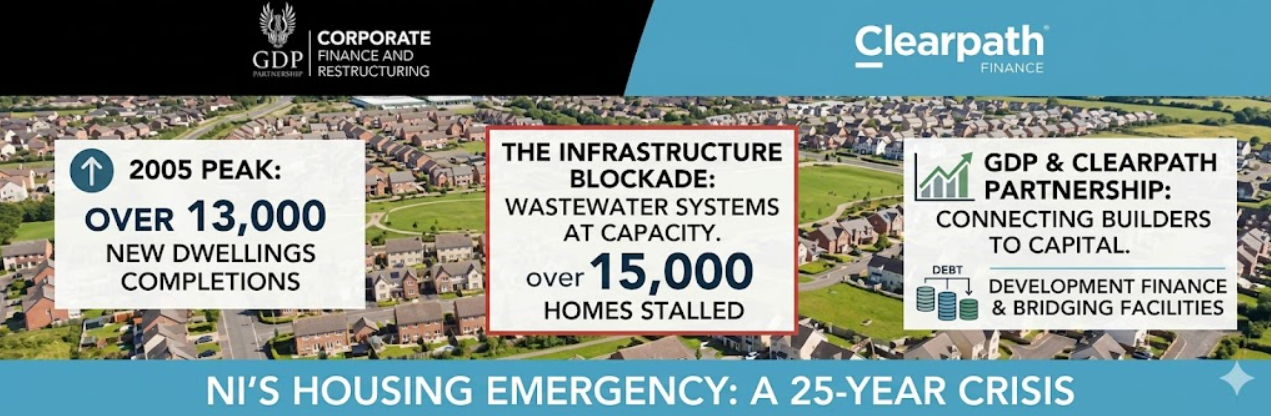
Around 2005, Northern Ireland's construction sector was in full stride, completing over 13,000 new dwellings that year as part of a sustained building boom that had run since the turn of the millennium. The post-Good Friday Agreement optimism, combined with accessible credit and strong demand throughout the Celtic Tiger years, was driving record output. Developers were active, land was moving, and homes were being delivered at a pace that broadly reflected what a growing, normalising society needed.
Talking about housing in particular, let's wind forward a decade to 2015, when the picture had changed dramatically. Completions in Northern Ireland had fallen to somewhere between 5,400 and 5,750 new homes — less than half the output of the mid-2000s peak. The financial crash of 2008 had ravaged the development sector, and recovery was painfully slow. Many smaller builders went bust, never to return to the building game. Those that did were working in a fundamentally different environment: tighter lending conditions, constrained land pipelines, and — critically — infrastructure that was already beginning to show the strain of long-term neglect.
By 2023, the situation had deteriorated further still. Total new dwelling completions fell to 5,380 — the lowest figure recorded since 1959. Housebuilding, by any honest measure, is at a sixty-year low.
The Infrastructure Blockage – how did we get here?
If you were to ask some of my builder-developer clients today what the main issue prohibiting the housebuilding sector in NI is, it is not planning policy, a lack of demand, the cost of materials, or even the availability of credit — it is wastewater infrastructure. Northern Ireland's sewage network is, in blunt terms, full. NI Water currently has 68 wastewater treatment works with no remaining capacity at all, and a further 107 networks operating under restricted capacity. The consequence is that new housing developments attempting to connect to the system can be — and routinely are — refused planning permission.
Trade body Build Homes NI has calculated that the development of over 15,000 homes is currently being actively impeded as a direct result of this infrastructure failure. The worst-affected areas are spread across the country: Mid Ulster alone has over 2,300 homes stuck in the pipeline; Belfast City has nearly 2,000 affected units; and Derry City and Strabane has approximately 1,775 stalled homes. These are not theoretical future developments — they are projects with land, with intent, and in many cases with finance ready to deploy. They simply cannot proceed because the pipes are full.
The scale of the economic damage is considerable. Research produced jointly by the NI Chamber of Commerce, the NI Federation of Housing Associations, and the Construction Employers Federation estimated that the poor state of Northern Ireland's sewage network is costing the economy £2.5 billion in Gross Value Added. NI Water's own research suggests that inadequate infrastructure investment could cost up to 17,300 potential jobs by 2027.
A Crisis of Chronic Underfunding
The causes of this infrastructure failure are not mysterious. NI Water has more wastewater overflows per head of population, and per kilometre of pipe, than anywhere else in the United Kingdom. This is the result of decades of chronic underfunding — a structural problem that successive budget cycles have deferred rather than resolved.
In December 2024, the NI Executive announced £19.5 million in additional funding to NI Water, covering investment across five council areas and unlocking connections for approximately 2,300 homes. It was a positive step — but 2,300 homes against a backlog of over 15,000 illustrates the scale of the gap between what has been committed and what is required.
By early 2026, the situation showed little sign of systemic improvement. Quarterly housing starts in the final quarter of 2025 fell to their lowest level since 2013 — just under 1,100 homes started between October and December, a 30% decline on the same period in 2024. Of those starts, only 51 were social housing. The social housing pipeline — already overwhelmed by demand — is, in effect, operating at a trickle.
The Real Human Cost
Behind each stalled unit is a household unable to find an affordable home. Northern Ireland's rental and house price inflation is currently the fastest growing in the United Kingdom — a direct consequence of supply failing to meet demand. Social housing waiting lists have lengthened substantially. Young professionals are being priced out of markets they grew up in. Families are doubling up. The housing emergency is not an abstraction — it is reshaping the lived experience of tens of thousands of people across the region.
The Finance Gap — and the Opportunity
There is, however, reason for cautious optimism — provided the right capital can get to the right people quickly enough. The builders and developers who want to help solve Northern Ireland's housing crisis are out there and ready to get on site. Many have existing sites, planning in principle, and the capacity to deliver. What they often lack is flexible, responsive development finance that meets their requirements.
At the present time, our own business, GDP PARTNERSHIP, is working on securing over £10M of development finance for some of our client base.
At the present time, it is fair to say that there continues to be appetite from both the Alternative Lending Market and the Private high-net-worth Investor market, along with the more mainstream lenders, who are thankfully back supporting the housing market with debt products over the last few years.
That is precisely why we are actively looking to connect with builders and developers who are working to bring new residential stock to market in Northern Ireland. Whether you are a regional housebuilder with a site ready to activate, a developer navigating infrastructure constraints and needing bridging or development finance, or a housing association seeking to structure funding for a mixed-tenure scheme — we want to hear from you.
It is important to say that there continues to be a different approach, as you would expect from the debt markets in relation to housing, but from your position, it is important that you have the “best in class” debt product that allows you to get on site and deliver stock. The gap between Northern Ireland's housing need and its current rate of delivery will not be closed by policy announcements alone. It will be closed by developers putting shovels in the ground — and that requires the right funding structures to be in place. We work with an elite panel of lenders who understand the local market, who are comfortable with the nuances of local infrastructure constraints, and who can move at the pace that development finance demands.
In my own view, the numbers from 2005 to today represent twenty years of lost momentum. If we are serious about housing, it will take sustained effort, meaningful public investment in infrastructure, and a private sector willing to step up.
At GDP, we are committed to playing our small part in making that happen, by assisting our clients with the working capital they need to assist delivery. Hence us currently looking for the builders and developers who share that ambition.
If you are a builder or developer active in Northern Ireland, or perhaps advise a client or number of clients active in this sector, who are looking for development finance, bridging facilities, or structured funding support, get in touch with our team at GDP Partnership.
Until next week, look after yourself.
All the best,
Conor