
Exits, Entrepreneurs and the Engine of a Healthy Economy
Last week, the Irish business world woke up to a headline that stopped people in their tracks. Salesforce, the global software giant, agreed to acquire Fin, the company formerly known as Intercom, for approximately $3.6 billion. It is the largest ever deal for an Irish-founded technology business, and I felt this week would be a worthy topic of discussion in this newsletter. Not just because of the scale of the sale price, but more because of what this kind of journey represents.
Behind every deal of this magnitude is a story of entrepreneurship - a situation where someone who had an idea backed themselves and refused to quit.
From a Dublin Coffee Shop to a $3.6 Billion Exit
Eoghan McCabe’s story is about as Irish as it gets. He grew up in Dublin, started building websites in his teens, and co-founded a string of software businesses before landing on the idea that would define his career.
Intercom was born in 2011, conceived when McCabe and his co-founders, Des Traynor, Ciaran Lee and David Barrett, noticed something simple: the owner of a Dublin coffee shop remembered her customers by name, knew their order, and made them feel valued. They asked themselves why online businesses couldn’t do the same.
What followed was one of the most impressive scaling stories in Irish business history. Intercom grew from zero to $50 million in annual recurring revenue in just two and a half years - a pace that, at the time, had only been matched by Salesforce itself. The company went on to raise over $240 million in venture capital, served more than 30,000 businesses globally, and surpassed $400 million in annual revenue.
But McCabe’s story is not just one of linear success. He stepped away from the CEO role in 2020 after battling serious illness, only to return and make one of the boldest calls in recent tech history: deliberately abandoning $60 million in annual revenue to pivot the entire business around artificial intelligence. The product was rebranded Fin, an AI-powered customer agent, and the bet paid off spectacularly. Weeks ago, the company finalised that rebrand. Last week, Salesforce came calling with a $3.6 billion cheque.
McCabe himself put it best:
“Salesforce invented modern software and SaaS. It’s a privilege to join forces with them at this most fascinating time.”
You don’t get to say that without having built something truly extraordinary.
Why Entrepreneurship is the Engine of a Successful Economy
The Intercom story is remarkable, but it is not unique. Across Ireland, north and south, there are founders building businesses from nothing, solving real problems, creating jobs, generating wealth, and putting their heads on the chopping block every single day.
This really matters, because entrepreneurship is not just good for individual founders; it is the lifeblood of a healthy economy. When a business is built, scaled, and eventually sold, the effects ripple outward:
Employees benefit from new opportunities and growth.
Supply chains and local economies experience increased demand.
Investors see returns that are immediately recycled into the next opportunity.
And perhaps most importantly, the founders themselves - now experienced, battle-hardened, and financially resourced - are highly likely to go and do it again. Research consistently shows that serial entrepreneurs are more successful than first-timers. The exit is not an ending; often it is a launchpad for more business ventures.
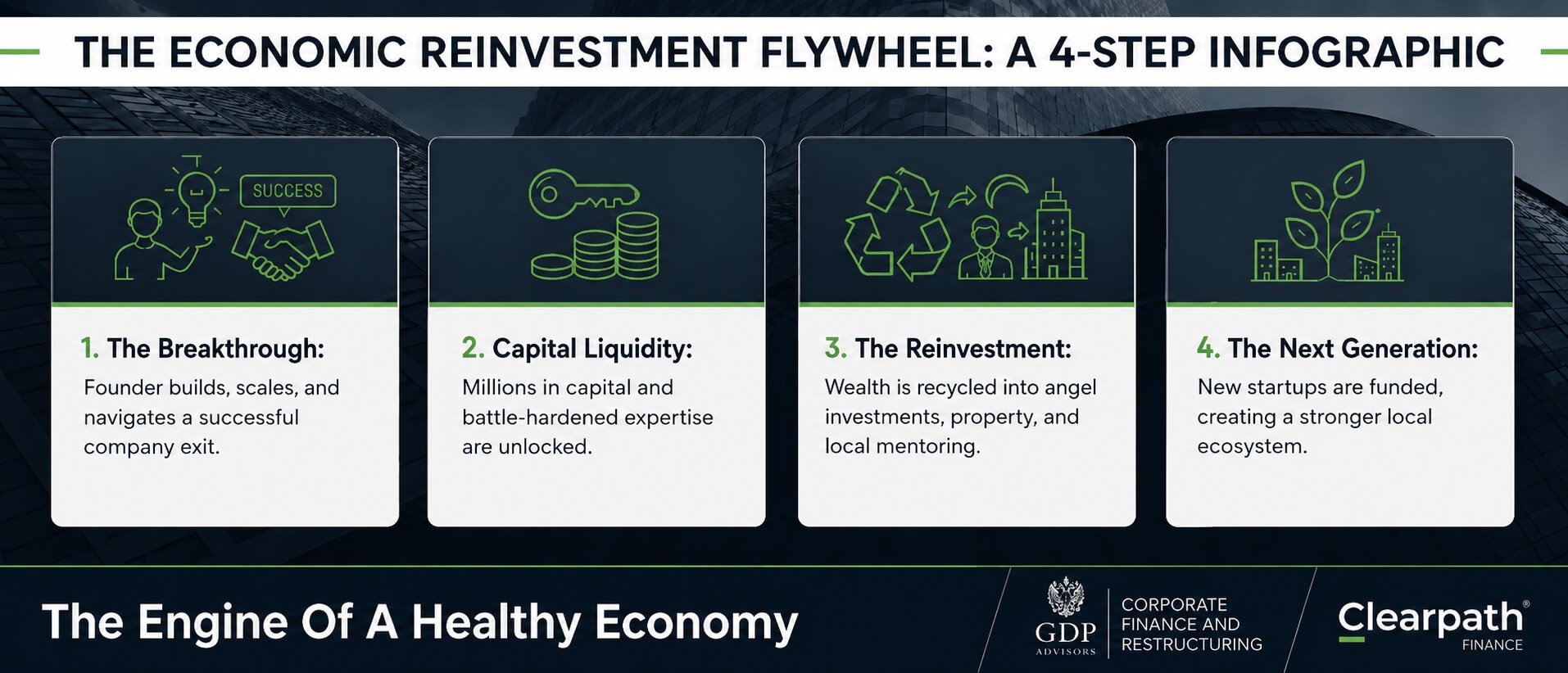
That is the flywheel effect that makes a strong entrepreneurial culture so valuable. Capital generated through a business exit does not disappear. It funds the next venture, backs the next founder, and keeps the big wheel turning.
Northern Ireland’s Own Story of Exits and Ambition
One of the frustrations for me living and working in Northern Ireland over the years is that we don’t have the same standard of journalism, or interest from journalists, in people who have been very successful here. My observations tell me that in the South they talk more about business, celebrate the important role of business, and champion success much more than in the North.
Despite this, I think it is appropriate that I try and remedy this in some way in this week’s newsletter by sharing how Northern Ireland has been quietly producing its own impressive chapter of deal activity over the past twelve months - something I feel is well worth celebrating.
1. TES Group
The most recent standout is TES Group, based in my hometown. The Cookstown-based specialist electrical engineering firm, founded in 1999 by Brian Taylor and Noel McCracken, was recently acquired. In April of this year, private equity backer Foresight Group announced its exit from TES to French electrical infrastructure giant Legrand Group, delivering a 4x return on invested capital. During the investment period, TES grew its revenues by 84% to £72 million and expanded its workforce by 60% to around 300 staff. The company had established itself as a key supplier of power distribution equipment to data centres and critical infrastructure across the UK, Ireland, and Europe. This is another Northern Irish business punching well above its weight on the global stage.
2. Kingsbridge Healthcare Group
Before that, Kingsbridge Healthcare Group - founded in 2005 by Dr Suresh Tharman and Dr Ashok Songra as 3fivetwo Healthcare - was acquired by private equity firm Exponent in 2024 following a sustained period of growth under Foresight’s stewardship. During the investment period, Kingsbridge’s revenues more than doubled and EBITDA increased tenfold, with the group expanding to over 1,000 staff across eleven sites. It is now the largest private hospital group in Northern Ireland, and a textbook example of what founder-led ambition combined with the right investment partner can achieve.
3. Hospital Services Limited
Additionally, Hospital Services Limited - a Belfast-based family business founded in 1962 - was sold to Asker Healthcare Group after growing revenues sevenfold to nearly £60 million under Foresight’s backing, with headcount rising from 30 to 175.
Three exits, three very different businesses, three stories of Northern Irish entrepreneurship creating real value.
Exits Fuel Starts: The Reinvestment Cycle
Here is something that often gets lost in the commentary around business sales: when a founder exits, the story rarely ends there. The proceeds of a successful sale do not sit idle. They fund new ventures, angel investments, property acquisitions, and the backing of the next generation of entrepreneurs. The founder who sells today becomes the investor, the mentor, and the co-founder of tomorrow.
This is the reinvestment cycle that underpins the most vibrant business ecosystems in the world - Silicon Valley being the obvious example, but also cities like Dublin, Manchester, and increasingly Belfast. Every exit strengthens the ecosystem. Every successful sale creates the conditions for the next breakthrough.
McCabe himself is a perfect illustration: Intercom was his third business, built on the back of two earlier exits.
TES’s founders built over twenty-five years before their global moment arrived.
For Northern Ireland to continue its current trajectory, we need more of this. More founders backed to build. More businesses scaled with confidence. More exits celebrated, not just as financial events, but as proof of concept—proof that it can be done here, with Northern Irish people, from Northern Irish soil.
A Final Word from GDP Partnership
At GDP Partnership, we spend every working day helping business owners navigate the decisions that define their futures. Whether that means securing the right finance to grow, structuring a deal to acquire a competitor, or beginning to think about what an exit might look like and when.
We understand that these are not just financial transactions. They are often life-defining moments.
The great news from within our own business is that we are currently advising several clients on both the acquisition and exit front. As previously mentioned on this platform, there is still a lot of appetite from the debt markets to support business owners with a positive balance sheet to make acquisitions, and we don’t see that changing throughout the rest of this year.
If you are thinking about your next move, whether that is growth, acquisition, or an exit, we would welcome a conversation. The best deals start with the right advice, early.
That’s all from me this week.
All the best,
Conor