
7 Lessons From 2026 So Far And What They Mean For Your Business
We're just over halfway through 2026, and it's already been a year that's tested SME owners' patience and, for others, rewarded their discipline in equal measure. Rate cuts, geopolitical shocks, a refinancing cliff edge, and a genuine appetite to invest have all been in play at once.
For this week’s newsletter, and given we are halfway through 2026, I wanted to share some thoughts and observations of how I see things right now for business owners. These are my own thoughts and observations of what I am seeing on the ground by speaking to several clients on a daily basis, and what it could mean for how you plan the rest of the year.
1) Rate Relief Hasn't Reached Your Term Sheet Yet
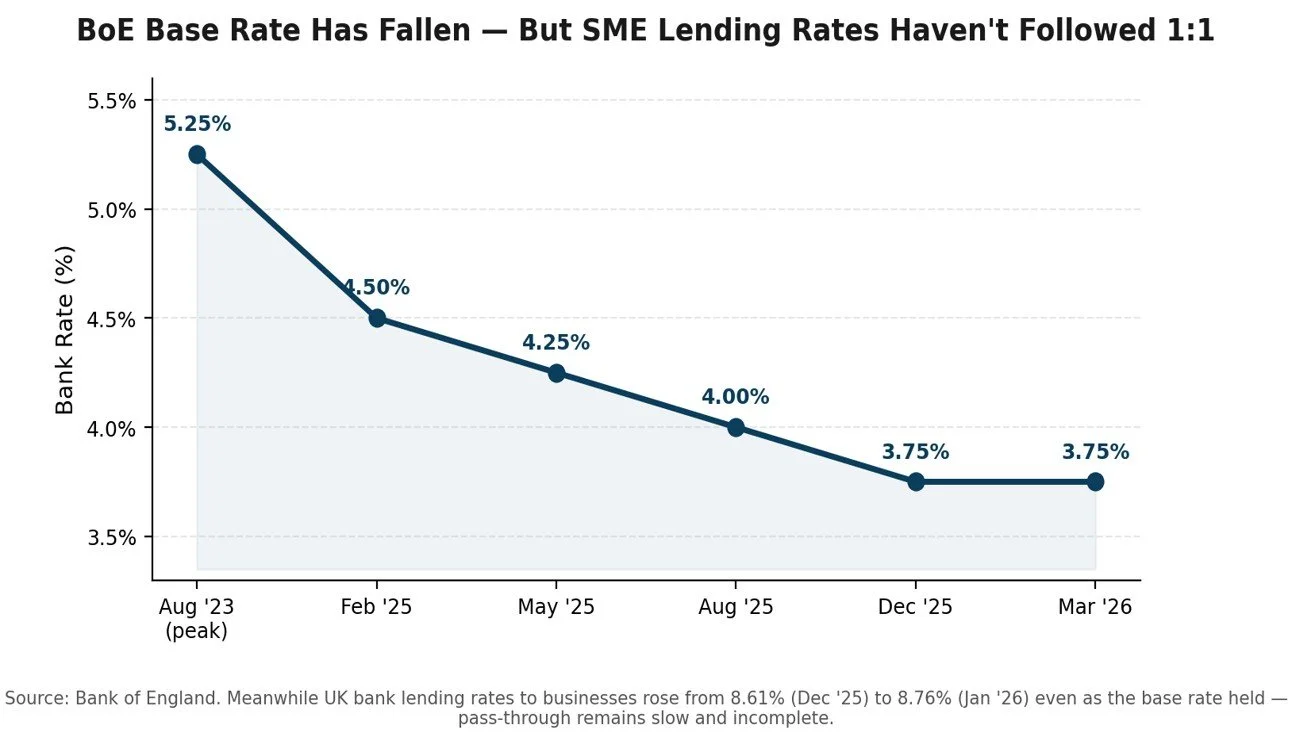
The Bank of England has cut its base rate from 5.25% at the 2023 peak down to 3.75%, and held it there through March as policymakers turned cautious on inflation risk driven by escalating conflict in the Middle East and rising global energy prices. The problem: commercial lending hasn't tracked the base rate down in lockstep. UK bank lending rates to businesses actually rose between December 2025 and January 2026, even as the base rate held steady. Don't assume the base rate story is your borrowing cost story; review covenants, tighten your credit story, and use competing offers to force better pricing. Vigilance remains the key when sourcing new funding lines and reviewing the cost of funds.
2) A Refinancing Wall Is Coming
A large share of commercial property debt taken out during the 2022-24 high-rate window matures over the next 12 months. Owners who fixed or agreed terms at the top of the cycle now face refinancing into a market where base rates have eased but commercial pricing hasn't fully followed, often against valuations that have moved too. Start the refinancing conversation now, not at maturity. Headroom, updated valuations, and a clean credit story all take time to build, and lenders reward borrowers who aren't refinancing under pressure. At GDP, we are advising our clients to look at this 12 months from your facility maturing. The problem we are seeing is that too many people are leaving this too late.
3) Waiting To Deal With A Debt Problem Is The Most Expensive Mistake We See
The pattern repeats every cycle: a business knows a facility is under strain, hopes trading will improve, and delays the conversation with its lender or advisor. By the time they act, the options that were available six months earlier—informal renegotiation, restructuring, a swift refinance—are gone, and what's left is a formal process, personal guarantees called in, or worse. The businesses that come through debt pressure intact are almost always the ones who moved early, while they still had leverage and choices. At GDP, we have been helping people since 2011; that’s 15 years in this space, with the clear observation being the more successful entrepreneurs do not procrastinate or kick the can down the road when it comes to problems or issues, particularly in relation to onerous debt challenges within their businesses.
4) NI Businesses Need Finance More Than They're Using It
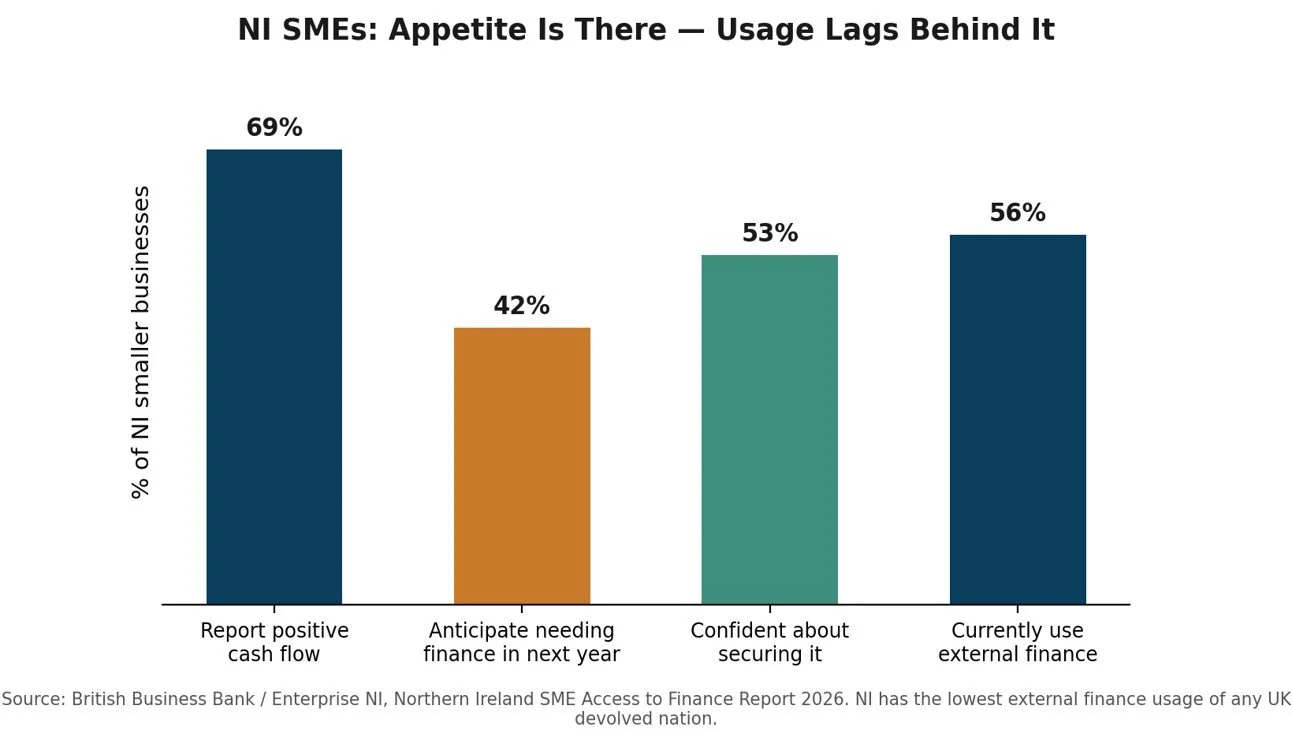
The British Business Bank's 2026 NI Access to Finance report found 69% of NI smaller businesses see their cash flow as positive and 42% expect to need additional finance in the next year, yet Northern Ireland has the lowest external finance uptake of any UK devolved nation. That gap between need and action is where deals get lost, and where good advice earns its keep. The key here is to get on the front foot, and if you are not clear on what options may be open to you, engage with people who can help you with this.
5) There's Real Appetite From Entrepreneurs To Back Good Opportunities
Beneath the caution in headline economic data, there continues to be a genuine willingness among NI business owners and investors to commit capital when the opportunity is right. We're seeing this first-hand: strong, active demand across development finance, hospitality, healthcare, and renewable energy this year. The constraint isn't appetite, it's structuring and getting the right capital to the right deal quickly.
Over the last ten years, the role private investors have provided in Northern Ireland when it comes to funding and injecting new capital into SMEs has been so important. We do not have any way of tracking this; however, anecdotally, and from my own experience, I would suggest that this part of the market has provided hundreds of millions of pounds to local businesses and it is a key part of the local funding pyramid - one very few people talk about. At GDP, we work with a number of family offices who are very active right now and will continue to be throughout the rest of this year, all looking for opportunity.
6) AI-driven Productivity Has Moved From “Interesting” To “Expected”
Northern Ireland's manufacturing base and SME-driven landscape are seen as well-positioned to close a longstanding productivity gap through automation and AI, backed by dedicated infrastructure investment. Businesses treating this as optional are increasingly the exception rather than the norm, and the gap between adopters and non-adopters will only widen from here.
Regular readers of my newsletter will have seen I have written about the role of AI in the last few weeks. My projections for the remainder of this year are that more and more business owners/SMEs will be utilising AI over the coming months, if they are not already. There is a lot to be optimistic about this moving forward.
7) The Best Buying Opportunities Show Up When Everyone Else Is Nervous
Markets and asset prices move in cycles, and history is consistent on this point: the businesses and investors who build lasting wealth are usually the ones acting while conditions are cautious, not chasing prices once confidence and competition have returned. Geopolitical tension, rate uncertainty, and pessimistic headlines are all suppressing prices and demand right now, exactly the environment that has historically rewarded patient buyers. This isn't a call to be reckless. It's a reminder that discipline and opportunity often arrive dressed as uncertainty.
I remember very well around 2006/07, when the Celtic Tiger was in full flow, liquidity was strong, and banks were champing at the bit to continue to support entrepreneurs with acquisitions and business support. Then Lehman’s went bust in 2008, and half the country and world was caught, as they had, in hindsight, acquired assets at the top of the market, only for everything to come falling down at a phenomenal rate.
What I continue to see today is that, yes, there is quite a lot of negativity in the markets, and liquidity is tight, but it is a very good time to buy, as value exists. Particularly those trying to refinance, who have left it too late, they are more likely to be in a position where they have to exit, which is good for any buyer.
We have seen this scenario play out locally within the shopping centre market in the last few years, where Forestside Shopping Centre in South Belfast, Foyleside Shopping Centre in Derry, and a number of others have all traded at a huge discount to the price which was paid for them only 10 years ago. I do expect this trend to continue throughout the rest of the year.
So, although times are challenging right now, and vigilance, along with being proactive and on the front foot, is the key to moving forward, there are and will continue to be plenty of opportunities.
At GDP, we are very active with our clients across a range of fields, so if you need some help, please get in touch.
Until next week, take care,
Conor