
Ambition Is Outrunning Success: Why Northern Ireland's SME acquisition boom needs a funding conversation now, not later.
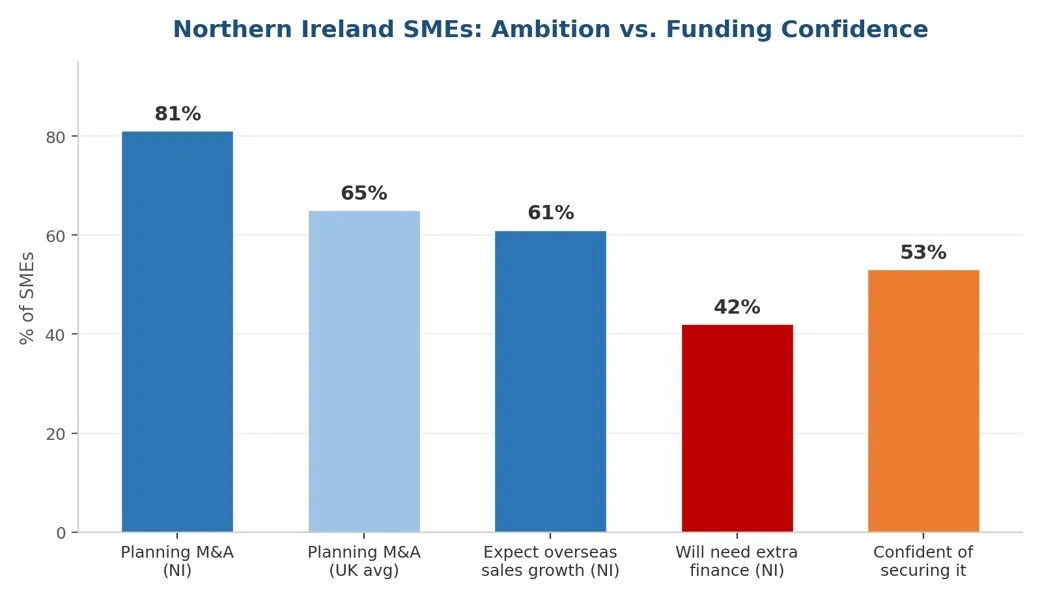
I've been looking at some new SME research this week, and one number caught my attention: 81% of Northern Ireland SMEs expect to explore M&A activity in the next 12 months. That's not a typo.
It's well above the UK national average of 65%, and it makes us one of the most acquisition-hungry SME markets on these islands.
Layer on top of that: 61% of NI SMEs expect overseas sales to grow this year, six points ahead of the national average. Whatever you think about the wider economic mood music, the businesses I'm talking to every week are not sitting on their hands. They're looking to buy, to expand, to push into new markets.
The gap nobody's talking about
Here's the problem. At the same time as this acquisition appetite, Northern Ireland has the lowest proportion of SMEs using external finance of any devolved UK nation. We're also the second most likely region to say we'll need extra finance in the next year, at 42%, only just behind Scotland.
Put plainly, a lot of business owners here have M&A plans in their head and no funding plan on paper. That's the gap I see most often in practice, and it's the one that kills deals at the worst possible moment, three weeks before exchange, when a lender starts asking questions that should have been answered months earlier.
It's already happening
This isn't just survey sentiment. Look at what's happened in the last few months alone in Northern Ireland:
Azets acquired Belfast accountancy firm Muldoon (June 2026), Azets' first move into Northern Ireland and a classic succession-driven sale for a firm into its fourth decade.
Dublin's FutureRange acquired Belfast IT services firm EOS Systems (January 2026), a cross-border consolidation expected to create up to 50 new roles.
Cordovan Capital, backed by industry specialist John Fitzgerald, acquired Bangor's Mayr Melnhof paper sack business earlier this year, a local buyer stepping in to keep a 50-year-old manufacturing business on the island.
Three very different sectors, three very different buyer profiles—professional services, tech, manufacturing—but the same underlying pattern: succession pressure, a strategic buyer with capital, and a deal that needed funding certainty to actually close.
In our own GDP business, we have been advising several clients in healthcare, hospitality, construction, and manufacturing around similar M&A aspirations, particularly around their funding requirements and what that might look like.
Debt or equity: the question that shapes the deal
Once funding is on the table, the next question is what kind. This is where I see owners default to whatever they've used before, rather than what the deal needs. One of the things that comes up, believe it or not, when I get into detail regarding funding options, is the lack of understanding around debt and equity.
Debt keeps you in control. Senior term debt, asset-based lending, or cash flow lending against the target's earnings is usually the cheapest capital available, and you keep 100% of the upside. But it only works if the combined business can service the repayments from day one. Lenders will look hard at integration risk, and a target with lumpy or unproven cash flow won't carry the debt load an owner might hope for.
Equity takes the repayment pressure off. Private equity, family office co-investment, or bringing in a partner gives you room to absorb a rockier integration or fund growth the target needs post-acquisition. The cost is dilution: you're giving away a slice of the business and a say in how it's run, permanently.
Blended structures are where most of the succession deals I'm seeing locally actually land. Vendor loan notes, earn-outs, and mezzanine finance all bridge the gap between what a buyer can raise in senior debt and what a seller wants for the business, without maxing out gearing or handing over control outright. In a market where 53% of SMEs aren't confident they'll secure the finance they need, a well-structured vendor note can be the difference between a deal happening this year or not at all.
The right answer depends on the target's cash flow, how much control you're willing to give up, and how much risk you can absorb if integration takes longer than planned. That's a conversation worth having before you're in exclusivity, not during it.
What this means if you're planning a deal
A few things I'd say to anyone in this position right now:
Get your financing lined up before you're in a deal, not during one. Lenders move faster and price better when they're not working against a completion deadline someone else has set.
Confidence about "securing finance" isn't the same as having it. Only 53% of SMEs who think they'll need finance feel confident they'll get it. That's barely better than a coin flip, and confidence isn't underwriting.
Cross-border ambition needs cross-border-literate funding partners. With overseas sales growth a live theme, the right lender needs to understand trade finance and multi-jurisdiction structures, not just a standard term loan.
The bottom line
Northern Ireland SMEs have the ambition. What's less certain is whether the funding infrastructure underneath them is keeping pace. If you're one of the 81% thinking about a deal this year, my advice is simple: have the finance conversation now, while you've still got the luxury of time. It's a far better position than having it once the clock is already running.
That’s all for this week,
All the best,
Conor