
So You've Been Offered Bridging Finance, Here's What to Actually Check
If you've been following our last couple of newsletters at GDP, you'll know we've been tracking the growth of the private credit and bridging finance market in Northern Ireland, and how much of it operates outside the visibility most business owners are used to with traditional bank lending.
This time we want to flip the perspective. Say you're the business owner. An opportunity has come up - maybe a stock purchase, a property completion, a VAT bill that's landed at an awkward moment - and a bridging offer has come across your desk. The rate looks high compared to what you're used to. The fees are unfamiliar. Is it a good deal? Is it even a sensible tool for your situation?
We've spent the summer on the other side of exactly this question, completing three property bridging deals for clients here at GDP, averaging 65% loan-to-value. In each case, the facility did what it was meant to do: it closed a short-term gap cleanly, without the client having to make a rushed or compromised decision elsewhere in the business.
On each of the three deals, we were also able to negotiate the exit fee out entirely - a real cost saving for the client, and one of the advantages of having an adviser at the table rather than going direct to a lender. All three clients are now in good shape heading into the next twelve months, with time to plan a proper refinance into longer-term finance rather than being forced into one under pressure. That's really the test of whether bridging finance has been used well: not just whether the facility completed, but whether it bought you the right kind of time.
Here's what we look at with every client before they sign a bridging term sheet.
The five things to interrogate
Is the exit strategy real, or just plausible? Every bridging lender will ask how you plan to repay the loan. The question is whether they're actually testing it, or just ticking a box so the fee can be earned. A good lender pushes back if your exit is vague. If yours didn't push back at all, that's worth noticing.
How is the interest structured? Rolled up, retained, or serviced monthly - these have very different cash flow effects. Rolled-up interest keeps monthly cash flow clear but means a larger sum due at the end. Serviced interest is gentler at the finish line but bites into cash flow now. Neither is wrong, but you should know which one you've signed up for and why it fits your situation.
What happens if you want to repay early? Some bridging products penalise early repayment, which rather defeats the purpose of a short-term facility. If your refinance completes faster than expected, you don't want the bridge to be the thing holding you back. On our three deals this summer, we were able to negotiate the exit fee out altogether - something not always possible, but it's always worth pushing for.
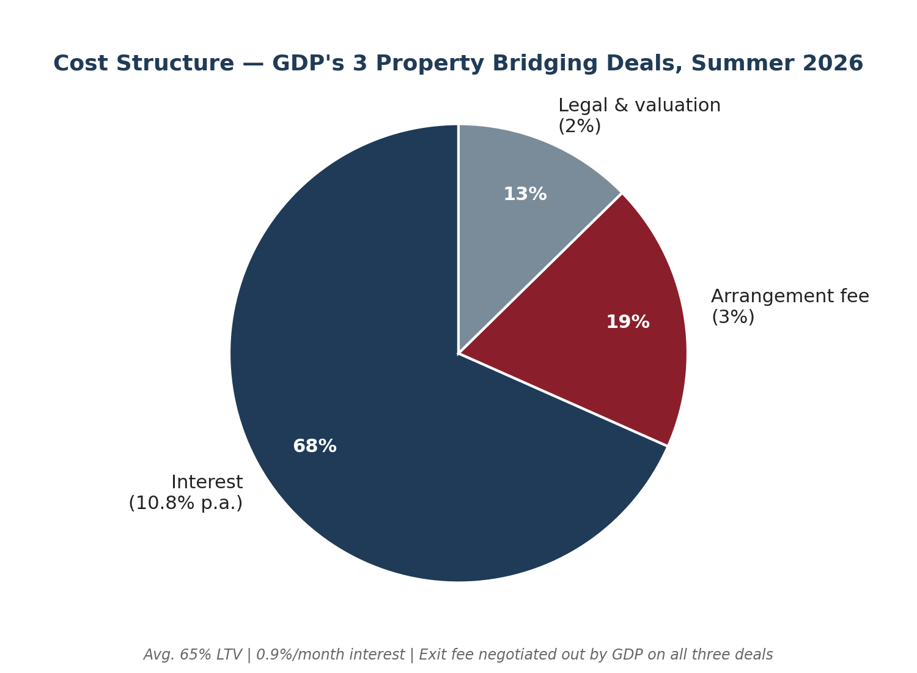
Who's paying for valuation and legal work, and at what speed? Bridging moves fast, and "bridging speed" often comes at bridging prices. Make sure you know these costs upfront rather than finding them buried in the completion statement. On our three summer deals this ran to roughly 2% of each facility.
What does the default rate step-up actually look like? This is the one people skip past. A facility that looks entirely manageable at the quoted rate can become a serious problem if your exit slips by even a month or two and the default rate kicks in. Ask for the number, not just the concept.
Where the money actually went across GDP's three summer deals: interest dominates the cost, arrangement fee runs a distant second. On all three, we negotiated the exit fee out entirely on the client's behalf.
Where the money actually went across GDP's three summer deals: interest dominates the cost, arrangement fee runs a distant second. On all three, we negotiated the exit fee out entirely on the client's behalf.
When bridging isn't the right tool
Bridging finance is excellent at what it's designed for: closing a defined, short-term gap with a clear and credible exit. It's a poor fit when the "gap" is really a symptom of an ongoing cash flow issue, or when the exit depends on something outside your control and hard to time (a sale falling through, a grant application, a buyer's own financing). In those cases, asset finance, invoice discounting, or a development facility structured for the actual timeline is usually the better answer, even if it takes a little longer to arrange.
That's really the judgement call at the centre of all this: bridging finance well used is a tool that buys you time on your terms. Used carelessly, it just moves the pressure a few months down the road.
If you have an urgent funding requirement and you are thinking you may require bridging finance, feel free to reach out to me, as I would be delighted to help with that.
That’s all for this week,
All the best,
Conor
GDP Partnership | Debt Advisory & Business Finance | Belfast