
A few weeks ago, I wrote that the banks are back: well capitalised, out looking for business, and competing for good deals. That is true, and it is good news. But for most of you receiving this newsletter, you will know that at GDP, we also continue to specialise in helping business owners deal with problem debt, and this is something that continues to raise its head and play a part in our business activity at GDP.
On the debt side, we are continuing to work with business owners who are struggling to repay their facilities and have fallen into arrears. Good people, running real businesses, who have been squeezed by higher interest costs, wage and energy bills, a slow-paying customer or two, and in some cases debt that was put in place for a business that looked very different a few years ago.
Almost every one of those conversations has something in common. The problem started months before anyone picked up the phone.
What the numbers are telling us

The latest Insolvency Service figures, published this week, make for sobering reading in Northern Ireland:
2025 was a tough year. There were 351 company insolvencies in NI, up 15% on 2024. The increase was driven by compulsory liquidations, which rose 56%.
2026 has been choppy. September saw 45 company insolvencies, 61% more than a year earlier, 30 of them compulsory liquidations. October eased to 29, down 40% on a very heavy October 2025.
The trend is going the wrong way. Over the 12 months to October, 40.3 in every 10,000 NI companies entered insolvency, up on the year before. In England & Wales, the rate is falling, and the Insolvency Service noted in September that NI's rate rose while both GB rates fell.
Monthly numbers in a market our size bounce around, so I wouldn't read too much into any one month. The figure that matters to me is the share of compulsory liquidations.
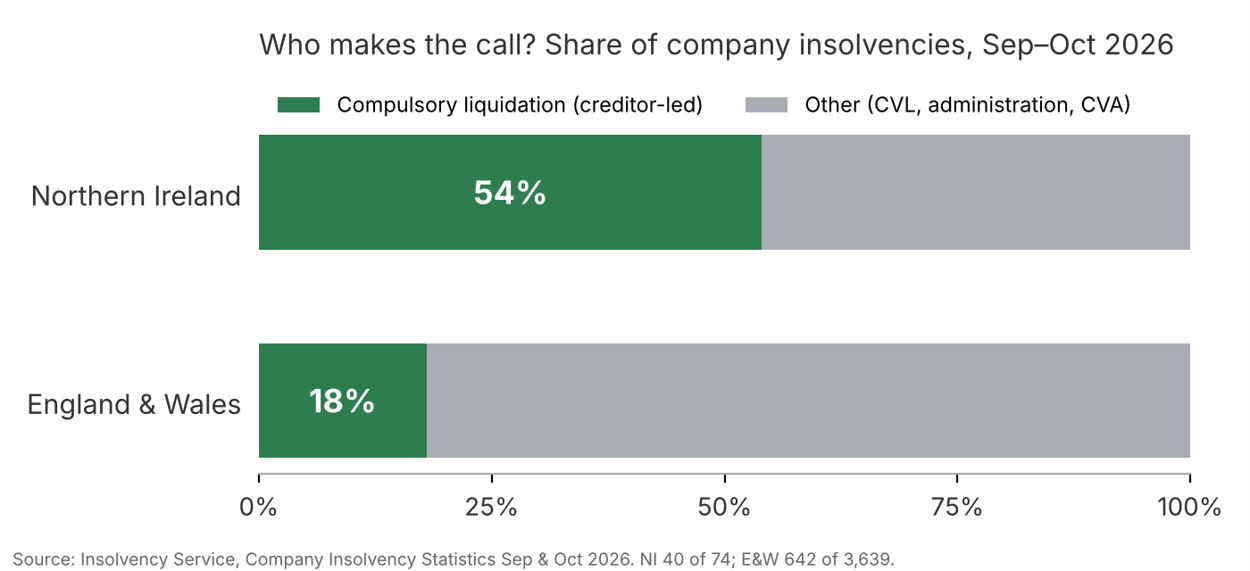
A compulsory liquidation is when a company is wound up by the court, usually on the petition of a creditor, very often HMRC. In other words, someone else made the decision. In England & Wales, the large majority of insolvencies are creditors' voluntary liquidations, where the directors themselves call time. Here, more than half of recent cases were forced.
That tells me too many NI business owners are waiting until the decision is taken out of their hands. And by the time a winding-up petition lands, most of the good options are gone.
Why owners bury their heads
I understand it. I have sat across the table from enough people to know the reasons are rarely about money alone. There is pride, there is the hope that next month will turn it around, there is fear of what the bank will do, and quite often there is a personal guarantee sitting in the background that nobody wants to think or talk about.
So the letters go unopened, the relationship manager's calls go to voicemail, and HMRC gets paid last. Each of those is understandable. Each of them makes the eventual conversation harder.
Here is the thing many owners don't appreciate: the bank does not want the keys to your business. Enforcement is slow, expensive, and usually recovers less than a workable plan would. What a bank cannot deal with is silence and surprises. A customer who engages early, with honest numbers, is someone they can work with. A customer who goes quiet becomes a case file.
The answer: be proactive, engage, and put a plan in place
Get on top of your numbers
Before you speak to anyone, know exactly where you stand. That means:
A 13-week cash flow showing what is coming in and going out, week by week, without the optimism.
A full debt schedule: every facility, lender, balance, rate, repayment, and maturity date, plus arrears with the bank, HMRC, landlords, and key suppliers.
An honest view of the business: is this a temporary cash squeeze, or is the debt simply too big for what the business now earns? The answer decides which plan you need.
Engage with the bank early, before they come to you
Make the call before the missed payment, not after it. Tell your lender what has happened, why, and what you are doing about it. Banks have a range of tools available for customers who engage, which can include:
Capital repayment holidays or interest-only periods to give the business breathing space.
Extending the term or reprofiling repayments so they match what the business can actually afford.
Resetting covenants that no longer reflect the trading reality.
Agreed asset sales to reduce debt on your timetable rather than a receiver's.
The same applies to HMRC. Time to Pay arrangements are far easier to agree when you approach them than when they have already started recovery action.
Put a credible plan in place, and stick to it
Goodwill only lasts so long. A lender will want to see a written plan with clear milestones: where costs are coming out, what is being sold, whether new equity is going in, and when the debt gets back on track. Under-promise and over-deliver. Report against it regularly, even when the news is not great. Credibility, once lost, is very hard to rebuild.
Sometimes the right plan is a refinance with a different lender. Sometimes it is a partial sale, a merger, or bringing in a partner. And sometimes it is an orderly exit, on your terms, which protects your reputation, your guarantees, and your family far better than a forced one.
A few things not to do
Don't plug a structural hole with expensive short-term money. Bridging or merchant cash advances can buy time, but at those rates they can also accelerate the problem.
Don't rob HMRC to pay the bank, or vice versa. Juggling creditors usually ends with all of them losing patience at once.
Don't go it alone for too long. Once insolvency becomes a real possibility, directors' duties shift towards protecting creditors. Get proper advice early.
How GDP can help
Debt advisory is where GDP started back in 2011, cutting our teeth helping clients work through the legacy debt left behind by 2008. We have been on both sides of these conversations. We can help you get your numbers in order, build a plan a lender will take seriously, and sit alongside you when you present it, or find alternative funding if your current lender is not the right home for the business anymore.
If you are behind on a facility, or you can see it coming, the best time to talk to us was three months ago. The second-best time is now. Every conversation is confidential.
Give me a call or email conor@gdpni.com.
All the best,
Conor
This newsletter is for general information and is not legal or financial advice.1