
In the last six months, GDP Partnership has delivered over £5 million of development finance for clients across Northern Ireland. Every one of those deals had two things in common: a borrower with a proven track record in development, and a contractor with a solid balance sheet behind them.
That's not a coincidence. It's exactly what lenders are looking for right now.
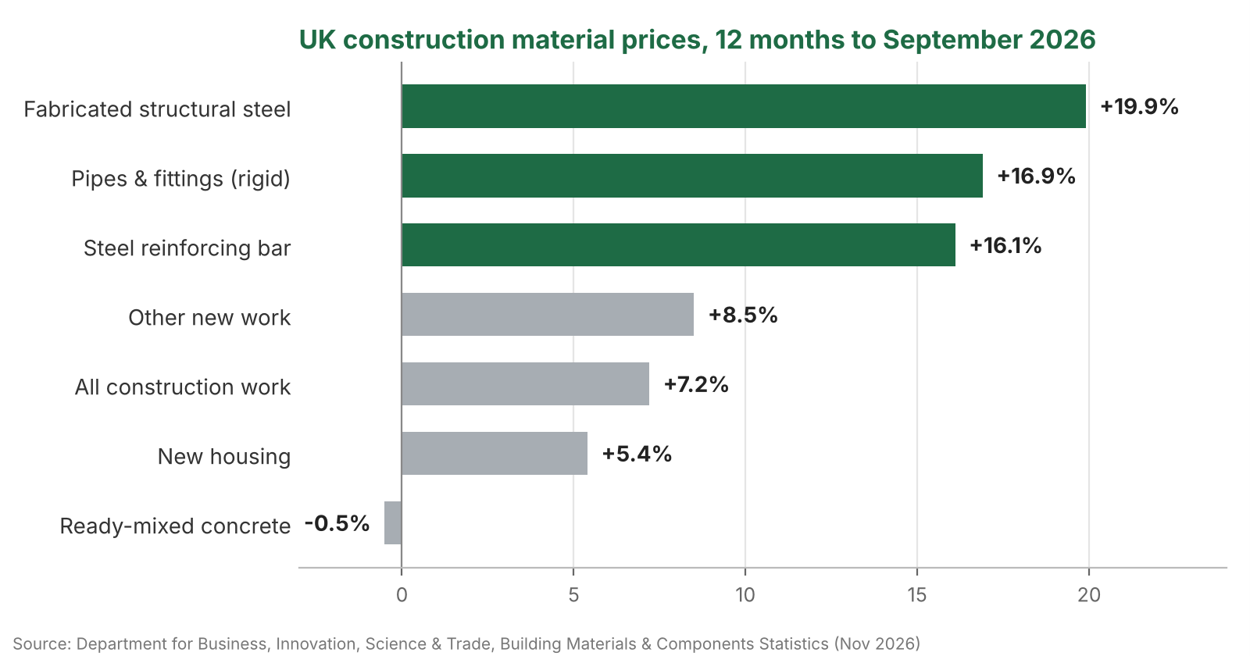
Construction material prices are up 7.2% in a year, with structural steel up almost 20%. Construction output has been shrinking for nearly two years, and margins across the industry are under real pressure. In that market, the bank isn't just lending against your scheme. It's lending against your builder.

The squeeze, in numbers
The official materials price index for all construction work rose 7.2% in the twelve months to September, up from 6.4% the month before. The averages hide the real pain. Fabricated structural steel is up 19.9%, rigid pipes and fittings 16.9%, and steel reinforcing bar 16.1%. Anyone building a frame, a basement, or anything with serious services is feeling it.
At the same time, the work isn't there. The UK construction PMI fell to 43.6 in October from 46.1, the sharpest drop in output since June and the 22nd month in a row below the 50 line. Fuel surcharges and energy costs are pushing input prices up again. The Construction Products Association now expects output to fall 4% this year, with private housing down 10%.
Closer to home, Northern Ireland surveyors told RICS earlier this year they expect profit margins to fall, with the gloomiest reading of any UK region. Nearly two-thirds reported a shortage of quantity surveyors. The CEF has been calling on the Executive to agree a capital budget, and with Stormont still without one, the public work that keeps many local contractors busy is stalled.
And here's the part that worries me most. Industry cost panels say the full effect of the Middle East conflict hasn't yet fed through to tender prices, and they've flagged insolvency risk among smaller contractors and suppliers locked into fixed-price contracts while costs swing. The price you're quoted today may not be the price the job actually costs to build.
Why this is holding the market back
Schemes that worked on paper 18 months ago don't work now. Costs are up, and with the Bank of England’s Base Rate moving back up to 4%, the cost of the money is up too. Developers are pausing. Lenders are stress-testing build costs harder. Contractors are either loading their prices with risk, or, worse, underbidding to keep the team busy.
Underbidding is the dangerous one. A contractor taking work at a thin or negative margin in a rising-cost market is the classic route to a mid-build collapse. When that happens, the client is left with a half-finished site, a cost overrun, a new contractor charging a premium to pick it up, and a lender asking hard questions. I've seen it too many times over 25 years. It is the single fastest way to turn a good scheme into a bad one.
If you're building anything: getting the right contractor
Check the balance sheet, not just the portfolio. Pull the last two or three years' accounts and run a credit check. Look at net assets, cash, and how much work they're carrying relative to their size. A great-looking previous project tells you nothing about whether they can survive yours.
Be wary of the cheapest tender. If one price is well below the rest, find out why. Either something is missing from the scope, or they're buying the work. Both will cost you later.
Talk to their subcontractors and suppliers. A contractor who pays late is usually a contractor under pressure. Trade references often tell you more than client references.
Get the contract right. Use a recognised form of contract, be clear on fixed price versus fluctuations, define the scope tightly, and agree upfront how variations are priced. In this market, who carries the materials risk has to be settled before you start, not argued about halfway through.
Build in security. Where the size of the job justifies it, consider a performance bond or parent company guarantee, retention, and confirmation of the contractor's insurances. Tie payments to certified valuations and never pay ahead of work done.
Have your own QS or employer's agent. Your lender will appoint a monitoring surveyor, but that person works for the bank. You need someone working for you, and with QSs in short supply, line them up early.
Carry a proper contingency. With materials up over 7% and steel up nearly 20%, a thin contingency is wishful thinking. On a new build, 10–15% is a sensible starting point for the conversation.
Bring your funder in early. The bank will look at your contractor as closely as it looks at you. A strong contractor on a properly drafted contract makes a facility far easier to approve, and on better terms.
What gets funded right now
The £5 million we've delivered in the last six months was all for residential development on housing sites on the outskirts of Belfast. Although there is not a lot of building going on across the board, it still proves the banks are willing to lend for construction.
Lenders want to support development opportunities in Northern Ireland, but they must be robust, make financial sense, and be put forward by builders/developers with a solid track record. Banks will back experienced developers with realistic appraisals and contractors who can see the job through. Get those two things right and you'll find not just one bank interested in supporting your deal. Get either wrong and the door is likely to close quickly.
Planning a build? Talk to GDP before you sign the building contract, not after. The funding structure and the contractor choice should be worked out together, and we can help you with both.
All the best,
Conor Devine
MRICS, Founding Partner, GDP Partnership