
Three Signals, One Week: Growth, Confidence, and How to Protect Business Value in Northern Ireland
Three stories landed in the space of a week that, taken together, say more about the state of financing in Northern Ireland than any single headline could. One is about growth. One is about confidence. One is a reminder that growth and confidence don’t reach every business equally. Here are all three, and what they mean depending on where you sit.
The Growth Signal
NISRA’s latest figures, published 24 September, show the Northern Ireland economy grew by 1.0% in the second quarter of 2026 to reach a new series high, with output 2.3% higher than the same quarter last year, outpacing UK growth of 0.4% over the quarter. Production led the way, up 7.8% over the year. Services reached a record output level, though annual growth there was a more modest 0.7%, still below the UK’s 1.6%. Retail was the one sector moving the wrong way, down around 2%.
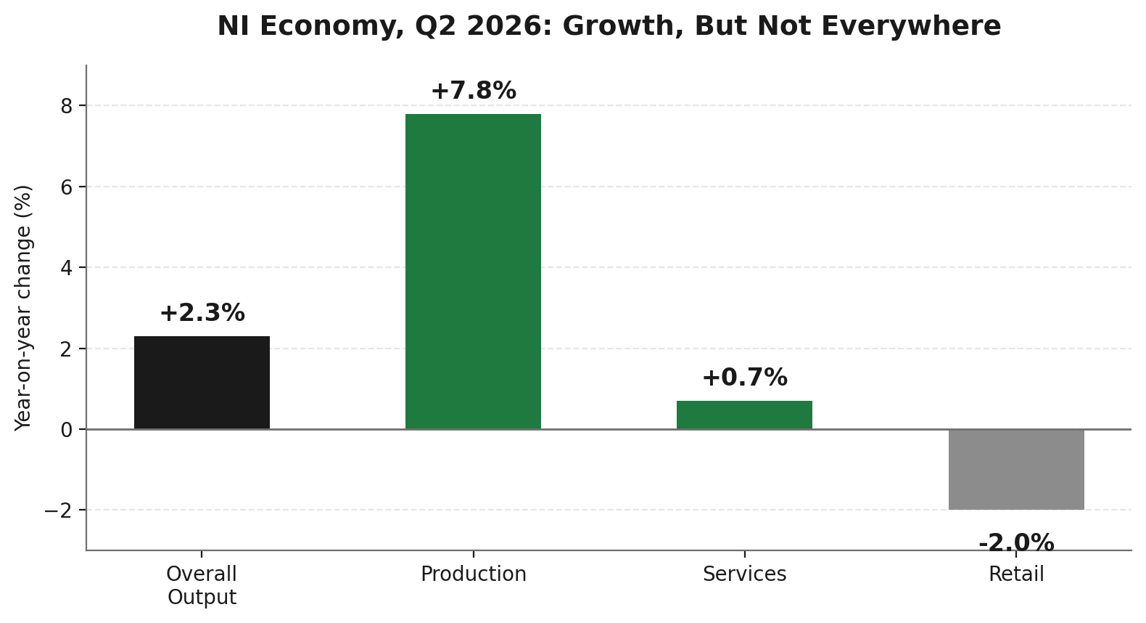
Source: NISRA, NI Composite Economic Index and Economic Output Statistics, Q2 2026
The lending market is backing that growth. Ulster Bank has agreed a £20 million loan with Radius Housing, Northern Ireland’s largest housing association, to fund the construction of hundreds of new social rent homes. It’s the first transaction of its kind completed by a Northern Ireland housing association under NatWest’s UK-wide £1 billion social rent loan fund, a discounted facility with reduced interest margins and no arrangement fee, aimed specifically at getting more affordable housing built.
That matters well beyond Radius. It’s a clear signal that mainstream bank appetite for well-structured social and affordable housing development remains strong, and that purpose-built, discounted lending products exist for housing associations who know where to look. This is exactly the kind of financing conversation we have regularly, sitting between housing associations, developers, and the banks who fund them.
The Confidence Signal
Belfast Harbour has confirmed that Bank of America has taken the remaining space at City Quays 3, leasing 58,000 sq ft across four and a half floors, bringing all fifteen floors of the building to full occupancy. It’s the largest office letting in Northern Ireland since the pandemic, and it comes as Bank of America builds out a Belfast hub expected to grow to around 1,000 roles.
In my old day job, when I worked as a surveyor in private practice from 2002 to 2010, I used to write the annual office take-up reports for what was BTW SHIELLS at the time. Twenty-odd years on, a deal such as this with Bank of America is a tremendous boost for both the local economy and the office market - a market that continues to be challenging for all stakeholders.
| A single anchor letting like this changes what the next phase of development actually looks like on paper.
For landlords and developers, this is the kind of event that changes what’s financeable. A fully let, blue-chip-anchored scheme is a different proposition to a speculative one, and Belfast Harbour already has planning permission in place for City Quays 4 and 5 as a result. Confidence like this doesn’t just benefit the scheme itself in that particular area; it improves the funding conversation for every landlord and developer bringing forward the next phase of commercial space nearby, and throughout the Greater Belfast area.
The Reminder
Not every story this week was a positive one. In the past few weeks, a couple of well-known Northern Ireland businesses have gone into administration, each telling a similar story: rising input costs squeezing cash flow faster than the business could adapt. In each case, the directors explored a range of options, including refinancing and investment, before concluding there was no solvent way through. It echoes a wider pattern too: Northern Ireland’s insolvency-related activity ticked up 18% quarter-on-quarter earlier this year, even as it remains down on the same period last year.
That detail is the one worth sitting with: refinancing and investment were explored, but by the time they were, the options had already narrowed to nothing. It’s a sobering illustration of a point we’ve made before - the businesses that get caught out are rarely the ones who acted too early on their financing. Growth at the national level doesn’t protect an individual business from cost pressure or a cash flow squeeze; only having the right conversation, early enough, does that.
Where GDP Fits In
These three stories sit across the exact range of relationships we work within every day: the banks who are lending, the housing associations who need funding to deliver schemes like Radius’s, the developers and landlords who need investment or development finance to bring forward the next phase once demand is proven (like the one Bank of America’s letting has created at City Quays). And, just as importantly, businesses under real cash flow pressure who need to have that refinancing/restructuring conversation while options still exist, not after they’ve run out.
Whichever side of these three stories you recognise your own business in, the message is the same one we keep coming back to: the earlier you start the financing conversation, the more options you have, whether you’re capitalising on growth or getting ahead of distress. If that’s where you are this week, that’s exactly the conversation worth having.
As always, if you think I can help you with any of this, please get in touch.
All the best,
Conor