
The Cutting Cycle Just Broke.
The US Central Bank, the Federal Reserve, just raised rates for the first time since 2023. The Bank of England came within three votes of following. Here’s why procrastinating on refinancing is not your friend right now.
For the best part of two years, the working assumption for anyone borrowing money has been simple: rates were on their way down, even if slowly, so there was rarely a cost to waiting. Last week, that assumption took a real hit. This week I decided to investigate this in more detail and share some of my thoughts on how it could impact you and your business over the next twelve months.
What Just Happened
On 16 September, the US Federal Reserve raised its benchmark rate by 25 basis points to 3.75%-4.00%, its first hike since 2023, approved unanimously. The move was driven by an oil-price shock from the conflict in the Middle East, which has pushed inflation back up even as the Fed had spent most of the last year cutting. Projections released alongside the decision suggest at least one more hike could follow before the end of the year.
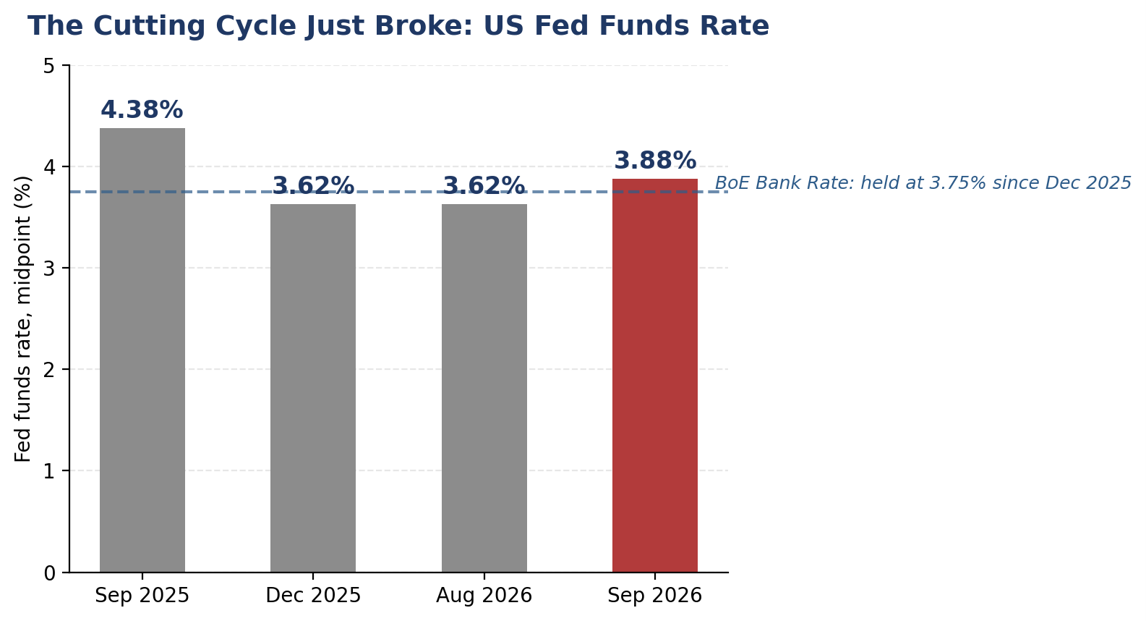
Source: US Federal Reserve; Bank of England
The very next day, the Bank of England held its own rate at 3.75%, but only just. The vote split 6-3, with three Monetary Policy Committee members voting for an immediate rise to 4%. UK inflation hit 3.1% in August, a five-month high, and markets are now pricing a hike as more likely than not at the Bank’s next meeting on 5 November, or the one after that in December.
| The assumption that rates only move in one direction just broke, on both sides of the Atlantic, in the space of 24 hours.
Neither move happened in isolation. Several major central banks are wrestling with the same problem: energy-driven inflation reasserting itself just as policymakers thought they were done tightening. Whether or not every central bank moves in lockstep, the direction of travel has genuinely shifted for the first time in years.
Why This Matters Closer to Home
This isn’t just a headline from Washington and London. I flagged a few weeks ago that UK 10-year gilt yields, the rate that prices longer-term business lending and mortgages, had been climbing steadily through the year, even while the Bank Rate sat still. That was the early warning sign. What’s changed now is that the base rate itself is genuinely back in play, not just the longer-dated borrowing costs underneath it.
For any business with a facility coming up for renewal, or plans to borrow in 2027, the planning assumption needs to shift. "Rates will probably be a bit lower by the time I need to refinance" is no longer a safe bet. It might be true. It might not be. And for the first time in a long while, the risk sits in both directions.
Why Procrastination Isn’t Your Friend
This is the part worth being direct about. Putting off a refinancing conversation because "the rate might come down if I wait" made sense in a market that had only moved one way for two years. It doesn’t make the same sense now.
Three members of the Bank’s own committee already voted to hike this month. If that view carries the day in November, any facility not already locked in before then goes into the new pricing environment automatically. There’s no version of "waiting to see" that gets you the old rate back once it’s gone, but there is a version where you lock in a rate now and refinance again later if things do ease off.
That asymmetry is the whole point. If rates fall further, a well-structured facility can usually be refinanced again down the line, sometimes with breakage costs, sometimes without, depending on how it’s written. If rates rise and you’ve done nothing, you’re simply paying more, for longer, with no equivalent way back.
There’s also a practical reality that gets overlooked: refinancing takes time. Between gathering financials, lender due diligence, valuations and legal work, a facility rarely completes in under a few weeks, and often longer for anything complex. If you only start that process after the November decision, you’ve already missed the window to act ahead of it.
Getting Your Ducks in a Row
None of this means panic; it means preparation. A few things worth doing now, regardless of what happens in November:
Know your maturity dates. If anything renews in the next 6-12 months, that clock is now more urgent than it looked a month ago.
Understand your exposure. Know exactly what’s on variable terms versus fixed, and what a further 25 or 50 basis points costs you in real terms.
Get current pricing while it’s still current. Lender appetite and rates can move quickly around a central bank decision. A quote taken today may not hold in November.
Start the conversation now, not after the decision. The businesses caught out are rarely the ones who acted too early. They’re the ones who waited for certainty that never came.
The debt markets remain open, and debt can still be secured on sensible terms. But the window to act ahead of the next rate decision, rather than in reaction to it, is exactly the kind of thing worth getting ahead of. If you’re not sure where you stand, that’s exactly the conversation worth having early.
Last week I shared some of the deals we’ve completed recently, from development finance to portfolio refinance. Every one of those facilities was priced and secured before last week’s rate moves, which is exactly the point. Although it is always difficult to predict where the markets are heading, it’s always worthwhile looking a little deeper into how the voting plays out at these monthly policy meetings, and what is clear today is that it’s more likely the cost of funds is going to increase as opposed to come down anytime soon.
That’s all for this week, and as ever, if I can help you with any of your funding or debt needs, please get in touch.
All the best,
Conor