
On Wednesday, John Healey delivered the first Budget of the Burnham government. After weeks of leaks, kites, and predictions, the reaction from most businesspeople I spoke to was a shrug. There wasn't much to get excited about, and there wasn't much to panic about either.
That's no bad thing. In 25 years of watching businesses in Northern Ireland borrow, build, buy, and sell, I've noticed the entrepreneurs who do well have never paid much attention to politicians. They don't wait for the Red Book to tell them what to do. They read the terrain as it is, adjust, and get on with it. A Budget is weather. It changes the conditions on the day. It doesn't decide whether you finish the course.
What Wednesday actually delivered
For the record, here's what matters for the businesses we work with:
Interest rates aren't coming down. The OBR now expects the Bank Rate to rise from 3.75% to 4.25% by mid-2027 and 4.5% by 2031. If you were waiting for cheaper money before refinancing, stop waiting. For any regular followers of this newsletter, you will know I have been saying this for some time.
Landlords take the hit. Tax on property income rises to 24%, 44%, and 49% from 2027/28 - four points above the rates set last year. Anyone holding investment property needs to re-run their returns and review their business plans.
Wages go up again. The National Living Wage rises 3.9% to £13.20 an hour. Hospitality and care will feel it most, which has been a common theme of late.
The banks pay more. The bank surcharge doubles to 6% for 15 months from January. The share prices went up on the day, so I’m hopeful it won’t dent their appetite to lend.
Rates relief, but not here. The small business rates threshold for retail, hospitality, and leisure rises from £12,000 to £18,000. Rates are devolved, so that's England only unless Stormont follows. What are the chances of that happening in Belfast?
More public money for business finance. An extra £20.4bn goes to the National Wealth Fund and British Business Bank. Positive news!
Some help on energy. Gas standing charges go from 2027, and the VAT cut on electricity runs to July.
Some of that helps and some of it costs. None of it decides whether a good business gets built here. For that, the more interesting question is closer to home.

What Stormont could do
Stormont doesn't set income tax, National Insurance, or VAT. Northern Ireland raises only around 5% of its own public spending, and the rest comes from the Treasury's block grant. But it isn't powerless. It sets business rates, it already controls Air Passenger Duty on long-haul flights, and a power to set our own corporation tax rate has been sitting on the statute book since 2015. I thought I would set out a few things we could do here:
Push hard for hospitality VAT to match the South. Since 1 July, a restaurant meal in Dundalk or Letterkenny carries 9% VAT. In Newry or Derry, it's 20%. That gap shows up in prices, footfall, and closures along the whole border. VAT isn't Stormont's to set, and the Treasury has already said no to an NI-only cut, but the case has never been stronger, and even this week I have heard more lobbying from stakeholders within the media for this. The Northern Ireland Affairs Committee is now taking evidence on it, and the Executive should be making this its number one ask of London. A cut for NI alone would cost a fraction of the £11bn the Treasury quotes for halving the rate across the whole UK. Partition has created two different economic structures on a small landmass, and over the last few decades in particular it is very clear which structure is working and which is not. It does seem to me unfair, and logical that, at a minimum, VAT on both sides of the invisible border should align to help businesses in the North.
Use the rates bill as a growth tool. This year Stormont put non-domestic rates up 3% while England has just widened its relief for hospitality and retail. At the very least, Stormont should match England's new £18,000 threshold and finish the job on revaluation. Reval2026 was pulled in February after hospitality pushed back, and businesses can't plan around a system that's stuck. Fix it with proper transitional relief and give people certainty. More emphasis needs to be put towards encouraging investment as opposed to increasing hard taxes on business owners.
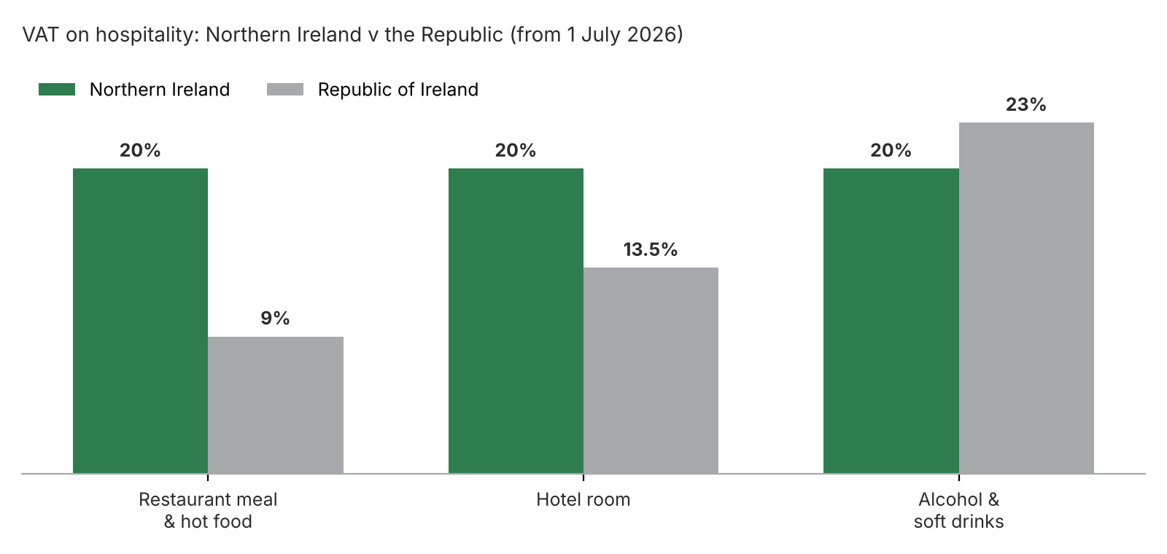
Source: Revenue/Ibec, HMRC. Drinks are taxed higher in the South. It's food and accommodation where we lose out.
Reward people who bring empty buildings back to life. The Back in Business scheme is a good start. Go further with rates holidays for anyone who refurbishes vacant upper floors or derelict buildings, especially for city-centre living in Belfast and the main towns. A building generating some rates is better than one generating none. Dereliction is a scourge on society, and right across Belfast and further afield, empty buildings have been sitting for years. For me, it’s a no-brainer to incentivise landowners to bring these properties back to life, creating employment, growth, and life across the community.
Make the case for the next set of powers. The Fiscal Commission set out the options in 2022: stamp duty, landfill tax, Air Passenger Duty in full, and more borrowing. Stamp duty is the one that matters most to us. Local control would let Stormont target first-time buyers, regeneration areas, or commercial investment instead of following rules written for south-east England.
Have the corporation tax debate properly. It's the biggest lever and the hardest one, because every pound of tax cut comes off the block grant. But we have 300 miles of a land border beside an economy that has used a low rate to attract investment for 30 years, and the power is already legislated. With the Windsor Framework giving us access to both the UK and EU markets, is it worth an honest, costed look rather than another decade of talking about it?
None of this needs a new Chancellor or a change at Westminster. It needs an Executive that sees its own tax powers as tools for growth, not just ways to fill a hole in the budget. Being honest with you on this one, my own view is that this ship may have sailed for NI plc, as the greater noise appears to be to investigate what an all-island economy might look like with full integration - something I will write about further in the not-so-distant future.
Meanwhile, back in the real world
I'm not holding my breath, and neither should you. The businesses that come through every cycle aren't the ones waiting on Stormont or the Treasury. They know their cash flow week by week, have access to capital before they need it, stress-test their debt at +2%, and move quickly when the numbers work.
So, file Wednesday's Budget where it belongs: something to factor in, not something to wait on. On Monday, do what entrepreneurs have always done here: take the terrain as you find it, run the numbers, and make your move. The banks are lending, the market is open, and there is good business to be done.
We are now well into Q4 of 2026 - where did this year go? For our clients at GDP, we are entering the busy period, as people try and get deals done and closed before the year-end. There are also many of you planning for Q1 2027, and within that exercise, you will be looking at your capital stack and funding requirements. That’s where we can help, so feel free to reach out for a discreet conversation.
Until next week, look after yourself,
All the best,
Conor