

Last week we looked at the insolvency numbers and who gets hurt when the cycle turns. This week I want to flip it around.
In over 25 years in this business, one lesson has stood out above most others: when rates go up (the tide goes out), things start to break. And when things break, opportunity appears for those in a position to move.
The turn has come
At the start of the year, most of the market expected rates to keep drifting down. Instead, on 5 November, the Bank of England raised Bank Rate to 4%, its first increase since 2023, and made clear that policy is not on a pre-set path.
For anyone carrying floating-rate debt, that bites straight away. Add a 3.9% rise in the National Living Wage from April, and a lot of businesses that were just about holding on will find the numbers no longer work.
The cracks are already showing
Northern Ireland company insolvencies in September were 61% higher than a year earlier. October was quieter, but the 12-month insolvency rate is still higher than the year before. Personal insolvencies were up 58% year-on-year in October. This is a sign that the pressure is moving from the company onto the owner who is on the hook for personal guarantees.
Every one of those numbers has a business, a building, or a loan behind it. Those assets don't disappear. They change hands.
What 2008 taught us
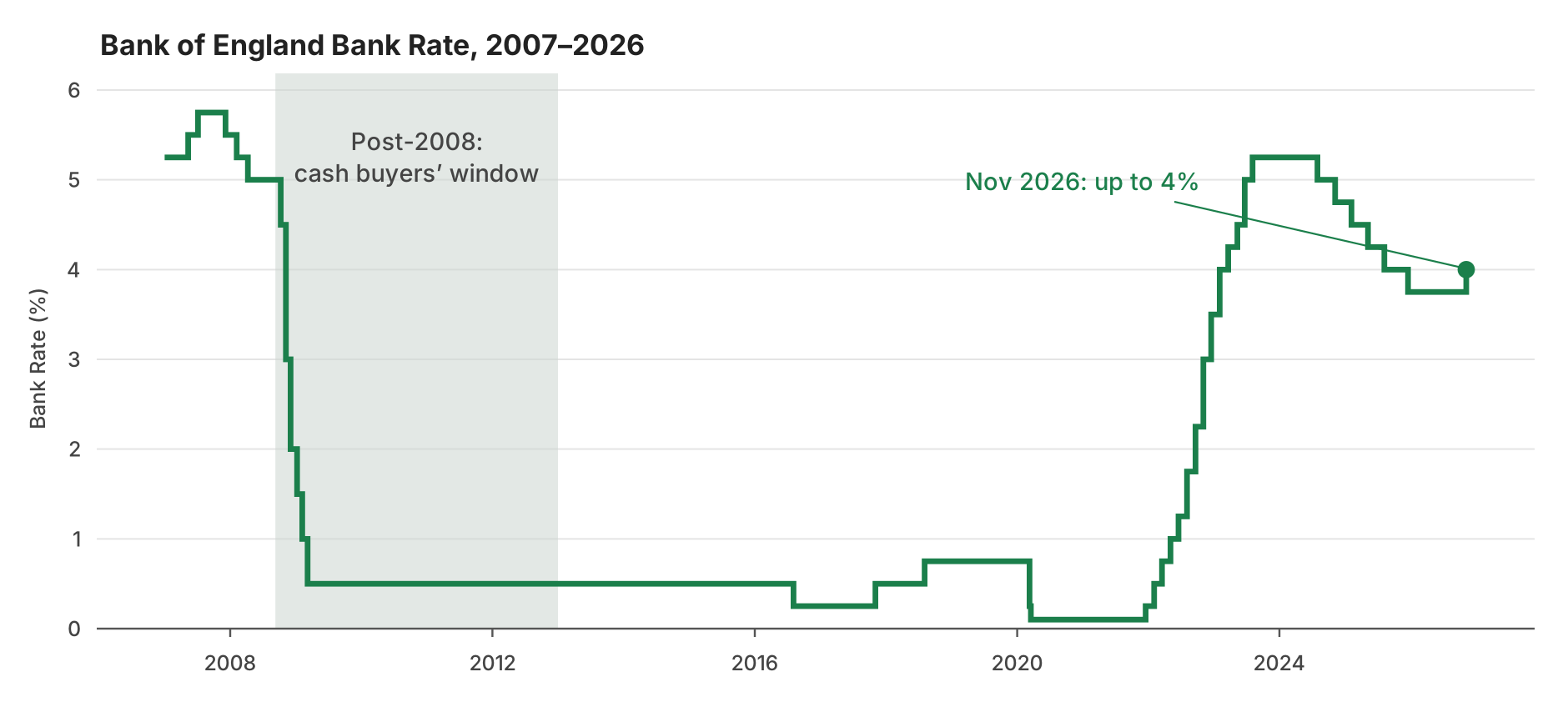
Source: Bank of England
After 2008, the people who did well weren't necessarily the smartest operators in town. However, they were the ones with cash, a clean balance sheet, and a funder willing to back them. Hotels, development sites, and trading businesses changed hands at prices nobody would have believed. Loan books were sold in bulk at pence in the pound, and assets came to market through receivers who needed a quick, certain sale.
That is part of the reason why we set up Clearpath Finance in 2016, as more people came out of the woodwork looking to trade again and get active in the property market post-crash. When the banks step back, speed and certainty of funding become worth more than price.
Where the opportunities will come from
Owners who can't refinance legacy debt at today's rates
Receivers and insolvency practitioners who need a quick, certain sale
Banks quietly reducing their exposure to problem loans
Good businesses with the wrong debt structure, where the answer is new capital or a new owner
How to be ready
Cash or committed funding in place before you need it. Distressed sellers won't wait for your credit committee.
Know the people who see the deals first. Insolvency practitioners, bank recovery teams, and the agents handling off-market sales.
Keep your own house in order. You can't take advantage of a downturn if it's squeezing you too. Stress-test your own debt at +2%.
Do the homework. A cheap asset can still be a bad one. Price is only part of the deal.
If you might be the seller
Not everyone reading this will be on the buying side, and I don't wish hardship on anyone. If the numbers are getting tight, the worst position to be in is a forced sale. Selling early, on your own terms and with time to run a proper process, almost always beats waiting for the bank or a receiver to set the price. With the Business Asset Disposal Relief lifetime limit halving to £500,000 for disposals from 6 April 2027, timing matters more than usual. If there was one piece of valuable advice I got from a certain client a number of years ago, it was “TIMING IS EVERYTHING”.
Summary
Cycles turn. They always have. Rising rates will bring real hardship for some and real opportunity for others, and the difference usually comes down to preparation: cash, funding lines, and relationships in place before the deal appears.
At GDP, we've advised on over £15M of off-market deals this year, on both sides, helping owners exit well and helping buyers move quickly. If you want to be ready for what comes next, the time to talk is now, not when the opportunity lands on the desk.
If I can help you with any of this, please get in touch.
All the best,
Conor