
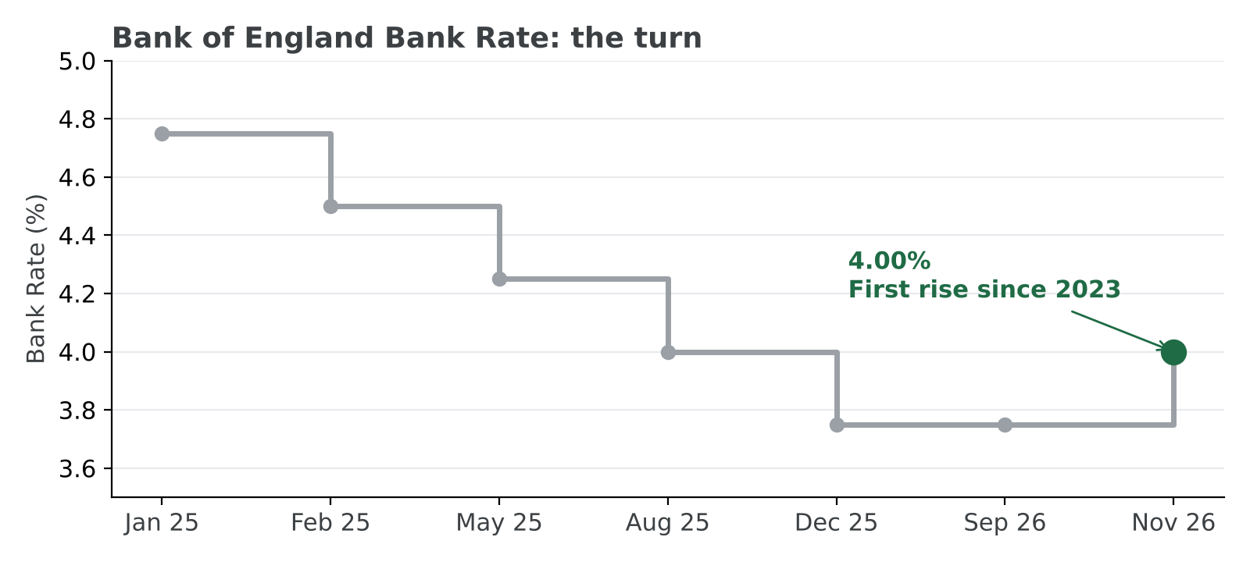
At noon on Thursday, the Bank of England raised the Bank Rate from 3.75% to 4%. It is the first increase since August 2023, and it ends any lingering hope that borrowing was going to get cheaper in the near term.
A few weeks ago, in “The Cutting Cycle Just Broke”, I said the September near-miss was a warning and urged owners not to sit on their refinancing. That warning has now been acted on. This week I want to set out plainly what the rise means for a business in Northern Ireland, and what I would be doing about it if it were my balance sheet.

Why the Bank moved
The driver is energy. The conflict in the Middle East has now run for nine months, global energy prices have kept climbing, and UK inflation rose to 3.5% in September. The Bank now expects inflation to approach 5% by the middle of next year and does not see it back at the 2% target until late 2028.
The Bank's judgement is that enough of that pressure is already in the pipeline to justify acting now rather than waiting. The Governor has also signalled that one further rise is possible if price pressures do not ease. Markets had been pricing in more increases through 2027. Nobody can tell you where the peak is, but the direction of travel has clearly changed.
What it means in pounds
A quarter of a percent sounds modest. On a variable facility, it shows up on the next statement. The figures below take an illustrative £1m loan priced at Bank Rate plus 3%:
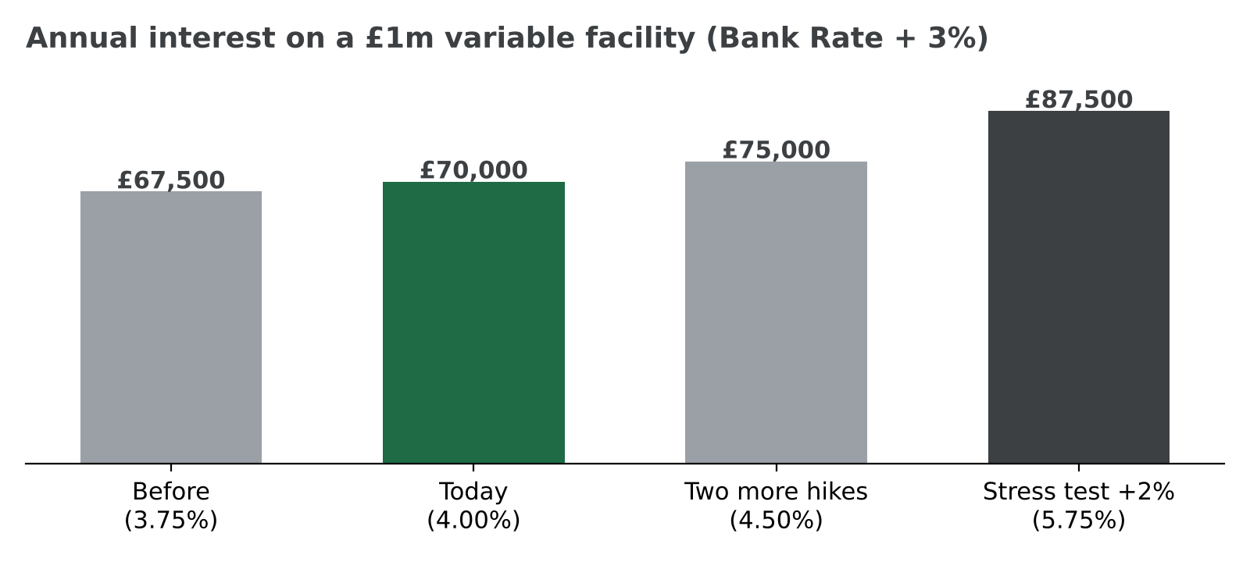
Today's move adds £2,500 a year. Two more rises would add £7,500. If you stress the facility at +2% from where we started (the test I'd encourage every owner to run, and the one credit committees will increasingly apply), the cost climbs by £20,000 a year. Scale that to your own debt and ask whether your cash flow absorbs it comfortably.
Who feels it first
Tracker and variable borrowers: The increase flows straight through to your repayments, usually from the next interest period.
Anyone refinancing in the next 12 to 18 months: New fixed rates are priced off market swap rates, which move on expectations. If your fix expires next year, today's terms are a better guide than whatever you signed in 2021 or 2022.
Businesses close to their covenants: Interest cover and debt service tests tighten as costs rise. A facility that passed comfortably in the summer can trip on the next test date.
Development projects: Where interest is rolled up, higher rates eat into contingency and profit on cost. Check the appraisal before the bank does.
Hospitality and energy-heavy businesses: These get hit twice - once on the energy bill and once on the borrowing. Margins that held last year may not hold this winter.
Five things to do now
Know your facility: Fixed or variable, the expiry date, the margin, the covenants, and when they are tested. If you cannot answer all of that in two minutes, find out this week.
Run the numbers at +1% and +2%: If the business still works at the higher figure, you are in a strong position. If it doesn't, you want to know now, not at renewal.
Talk to your bank before it talks to you: As I wrote in “The Banks Are Back”, the mainstream banks are well capitalised and want to lend. That hasn't changed. What changes is how hard they stress your numbers. Owners who arrive early with a clear plan get better outcomes.
Think about certainty versus flexibility: Fixing or hedging part of your debt buys certainty but can carry break costs and leaves you exposed if rates later fall. There is no universal answer. It depends on your plan and how much volatility your cash flow can take.
Watch your working capital: Rising energy, wage, and borrowing costs all land at once. Tighten debtor days, review overdraft headroom, and do not let a profitable business run short of cash.
Some perspective
I have been working in this space now for over 25 years. Bank Rate at 4% is not a crisis. It was 5.75% in 2007 and 5.25% as recently as 2023, and plenty of good businesses grew through both. Money is not expensive by historical standards. What matters is the direction of travel and whether your plans were built on the assumption that rates would keep falling.
The businesses that get hurt in a rising rate cycle are rarely the ones with the most debt. They are the ones that did not look at it until the letter arrived. Good businesses with sound plans will still get funded, will still grow, and will still succeed. They just need to be better prepared than they were a year ago.
Talk to us before you talk to the bank. If you have a facility coming up for renewal, a variable loan you are unsure about, or a project whose numbers now look tighter, we will review your position and tell you straight where you stand. Feel free to send me an email at conor@gdpni.com.
All the best,
Conor
Figures in the worked example are illustrative only and do not constitute financial advice. Speak to an adviser about your own circumstances.