
This Time, We Might Not Catch the Cold: Why NI’s Returning Shoppers Are an Opportunity
America’s consumers are spending on borrowed time. Ours are in better shape than the headlines suggest, and Northern Ireland’s returning shoppers are an opportunity waiting to be turned into sales.
When America sneezes
There’s an old saying that when America sneezes, we catch the cold. More often than not, it holds true: US downturns, interest rate moves, and market shocks have a habit of crossing the Atlantic within months. So when the Wall Street Journal reported last week that Americans are spending their way through inflation, it was worth asking whether the same thing is happening here, and whether we should be worried. The answer is more encouraging than you might expect.
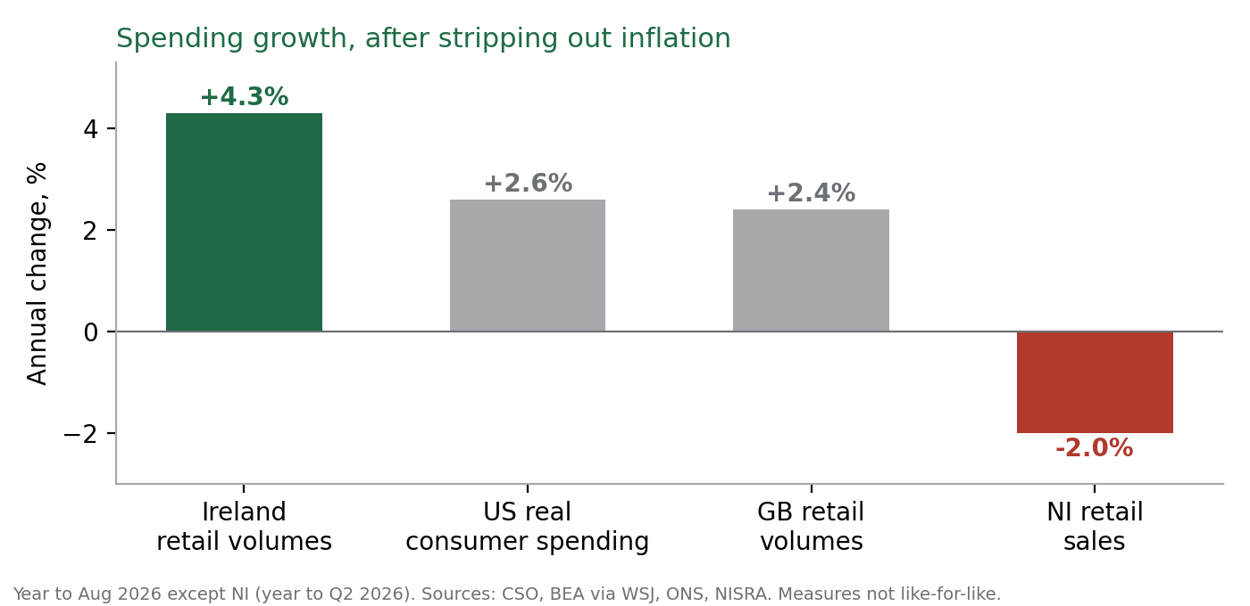
The Journal described a striking contradiction. Americans feel dreadful about the economy, with sentiment surveys near record lows, yet household spending rose 6.1% in the year to August, or 2.6% after inflation. The National Retail Federation’s chief economist summed it up neatly: consumers are “spending their financial condition, not their psyche.”
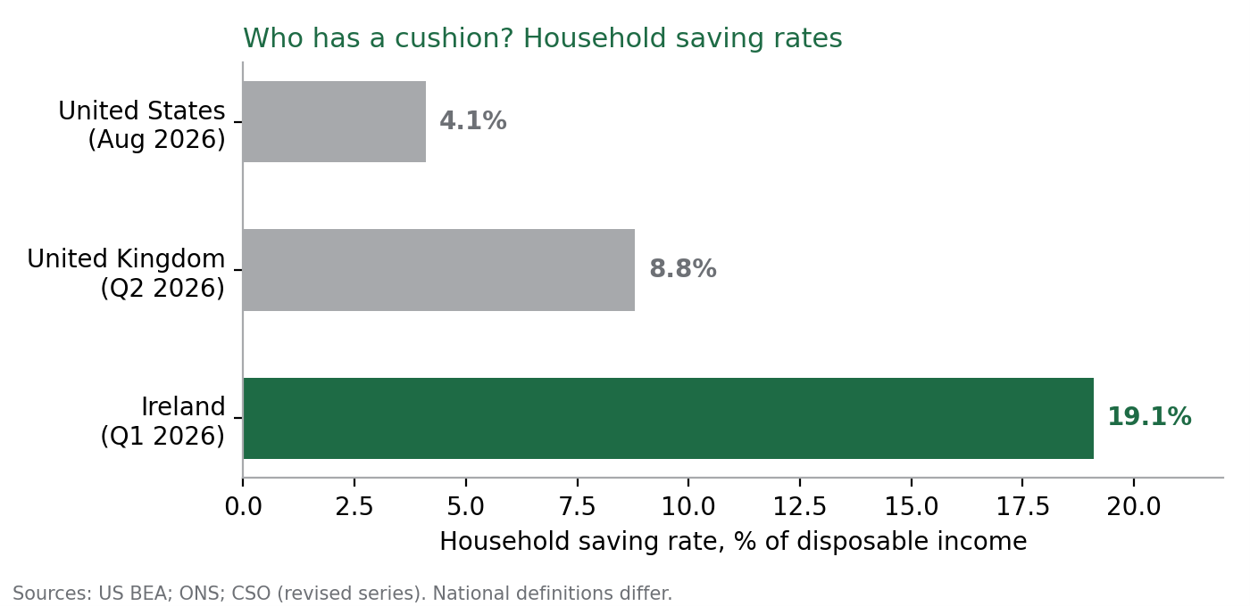
The catch is how they are paying for it. The US saving rate has fallen to 4.1%, about half its pre-pandemic level, and household debt is at a record. EY-Parthenon’s Gregory Daco warned that savings, credit and wealth are all finite. That is the part that should worry Americans. It is also the part that sets us apart.
Ireland: The deepest pockets on the island
South of the border, consumers are just as gloomy on paper. The Credit Union sentiment index sits at 61.1, well below its long-term average of 83.0. But they are spending regardless: retail volumes were 4.3% higher in August than a year earlier, with every sector growing and department stores up 9%.
Crucially, they are doing it from strength. After a recent CSO revision, the Irish household saving rate stands at 19.1%, among the highest in the eurozone, with around €175 billion sitting in deposits. Unlike Americans, Irish households are spending out of income and still putting money aside. Today’s budget, with an €8.5 billion package including €1.5 billion of tax measures, should put a little more in their pockets. For Northern Ireland businesses, that is spending power right on our doorstep.
Irish households save more than four times the US rate. That is staying power, not a spending spree on credit.
Britain: Confidence on the mend
In Britain, the mood is slightly improving. GfK’s consumer confidence index rose to -13 in September, its highest level in more than two years, with households more upbeat about their personal finances. They are also being prudent: the household saving ratio edged up to 8.8% in the second quarter, more than double the American rate.
That caution is a strength, not a weakness. Money saved now is demand held in reserve, ready to come back into the economy as inflation eases. Meanwhile, the wider economy is outperforming expectations: second-quarter growth was revised up to 0.5%, and the UK received Europe’s largest investment inflows last month. GB retail volumes were 2.4% higher in August than a year earlier.
Northern Ireland: The customers are coming back
This is the most encouraging part of the story. In April, NI shopper footfall fell 14.3% on a year earlier, the worst result in more than five years. It has recovered every month since, and in August Northern Ireland was the only UK region where footfall rose, up 2.8%.
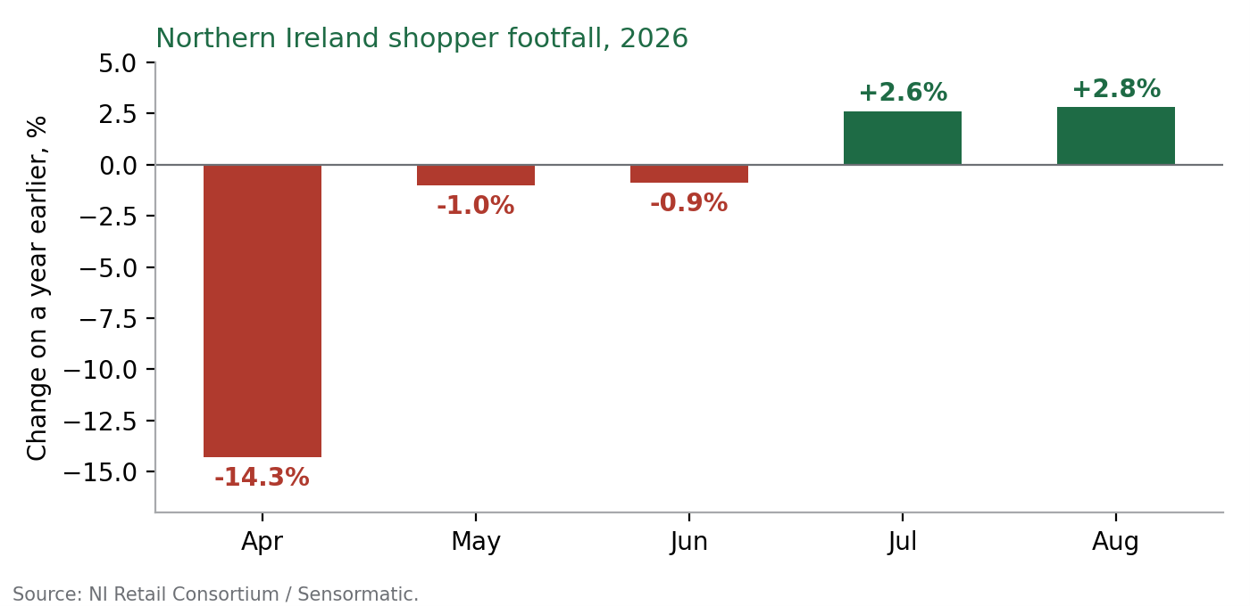
From the worst April in five years to the best performance in the UK by August.
The official sales figures have not caught up yet. NISRA shows NI retail sales 2% lower than a year earlier, but those figures cover April to June and include that dreadful April. The footfall recovery came afterwards. Footfall tends to lead sales, and the people are back on the streets. The wider NI economy is in good health too, with production output up 7.8% over the year.
There is still a gap between visits and spending, and it is worth being clear-eyed about why. Many NI households are paying more to fill the heating oil tank, and fewer hold the kind of investments propping up American spending. But a customer through the door is the hardest part of retail and hospitality. Converting that visit into a sale is something businesses can influence.
“For Born and Bred, we are very optimistic about the next twelve months and following the successful opening of our second retail unit in the Abbey Centre, we are in discussions about further openings in 2027.” - Linzi Rooney, Owner, Born and Bred
Five reasons for optimism
Our consumers have savings, not debt. UK households save more than twice the US rate, and Irish households more than four times. That makes spending here more durable than in America.
The deepest pockets are next door. Southern consumers hold around €175 billion in deposits and have a budget designed to ease their costs. NI businesses have direct access to that all-island market.
The footfall is back. NI has gone from the worst footfall in the UK to the best in four months. The customers are there to be won.
Britain is beating expectations. Growth has been revised up, confidence is at a two-year high, and international investors are moving money into the UK.
Caution is stored-up demand. Households that are saving now have the means to spend when inflation turns. Businesses positioned for that moment will benefit first.
Making the most of it
Focus on conversion. Track average transaction value and conversion, not just how many people come through the door. Small improvements in either are worth more than chasing extra footfall.
Plan for the southern customer. Border towns and Belfast alike should think about how they attract and serve visitors from the south, including how they price and promote.
Back growth with evidence. Lenders will support expansion that is grounded in real trading data. Rising footfall plus improving transaction values is a compelling case to put in front of a bank.
Stay optimistic, not complacent. Interest rates may still rise, as we set out last week in “Price the Hike Before It Lands”. Structure any new borrowing so it holds up either way.
The bottom line
America has the sneeze. But our consumers are holding more savings, our neighbours have spending power to spare, and Northern Ireland’s shoppers are coming back. This time, there is good reason to think we can avoid catching the cold, and for businesses ready to turn returning customers into sales, the months ahead could be a real opportunity.
Here at GDP Partnership, we are continuing to work with and advise clients across Northern Ireland on funding, alongside the strategic growth plans that make that funding work. If you are weighing up investment or expansion, get in touch.
Until next week, all the best,
Conor Devine MRICS
Founding Partner, GDP Partnership
Sources
Wall Street Journal, US consumer spending feature, October 2026 (citing US Commerce Department, University of Michigan, NRF, EY-Parthenon); Credit Union Consumer Sentiment Index, September 2026; CSO Retail Sales Index, August 2026, and household saving data; Government of Ireland Budget 2027 package; GfK Consumer Confidence Barometer, September 2026; ONS Quarterly Economic Commentary, April–June 2026, and Retail Sales, August 2026; HSBC European fund flow data, September 2026; NISRA economic output statistics, Q2 2026; NI Retail Consortium / Sensormatic footfall data, April–August 2026.
Measures are not directly comparable across countries: US figures cover total consumer spending, while UK, Irish and NI figures cover retail sales. This briefing is for general information only and does not constitute financial advice.