
Banks Are Booming - So Why Are So Many Loan Applications Failing?
If you've felt like getting a straight answer out of a bank regarding business finance has become harder work than it used to be, the numbers back you up, along with telling a very odd story. The banks themselves have never been in ruder financial health. Yet for a large share of Northern Ireland SMEs, the loan application process is still ending in a 'Computer says No'. Here's why both things are true at once, and what it means for how you approach your next funding conversation.
Part One: The Banks Have Never Had It So Good
Half-year results published across late July and early August confirm it: 2026 is shaping up to be one of the strongest years on record for the banks serving the Irish and Northern Irish markets.
€939m — AIB profit after tax, H1 2026, with return on tangible equity of 23.2%
€960m — Bank of Ireland pre-tax profit, H1 2026, up 33% year-on-year
£135.4m — Danske Bank UK pre-tax profit, H1 2026, up 14% year-on-year
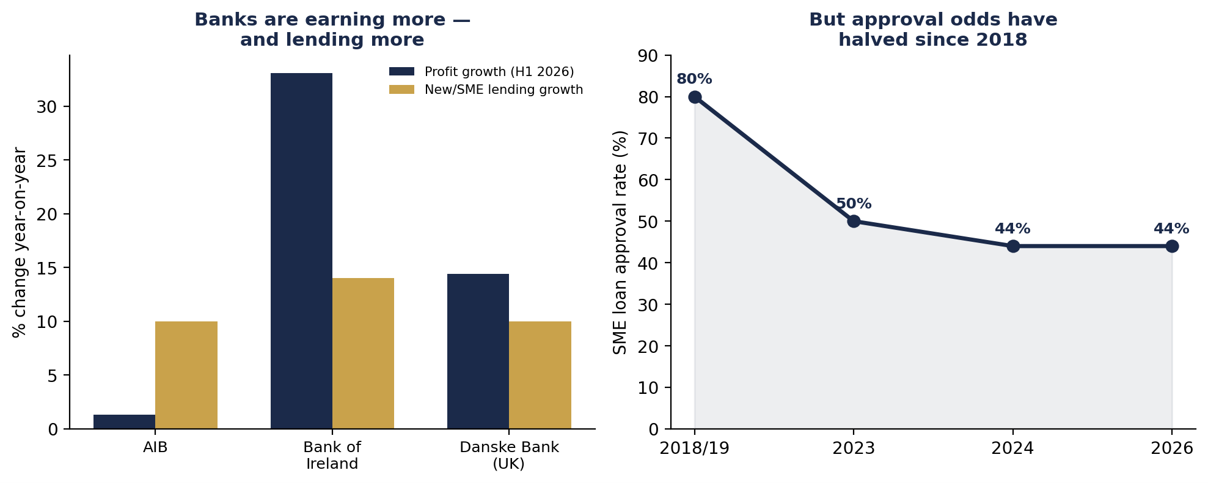
What matters more than the headline profits is where the growth is coming from: new lending.
AIB grew new lending 10% year-on-year to €7.5 billion, with new SME lending in Ireland rising to €0.9 billion. Bank of Ireland's Irish Corporate and SME lending book grew 14%, the standout figure in its results.
Danske Bank UK approved over £400 million in Northern Ireland business lending in the first six months of the year alone, backing recognisable local names like Andras House, Donnelly Group, and several housing associations.
Put simply: capital is strong, appetite is up, and the three main banks serving Northern Ireland businesses are actively competing for good lending. That's a genuinely favourable backdrop, if you can get your application in front of the right person, in the right shape.
Part Two: So Why Are Applications Still Failing?
Here's the part that doesn't fit the headlines. Despite all that appetite and capital, approval odds for SME borrowers have fallen sharply over the same period that bank profits have climbed.
SME loan approval rates have fallen from around 80% in 2018/19 to roughly 44% today, meaning more than half of applications are now declined.
SME loan rejection rates overall have climbed from 5–10% three decades ago to around 40% today, according to Allica Bank research.
Only around a third of SMEs planning to apply for finance are confident their bank will approve it, down from 56% in 2019.
Roughly half of SMEs who are rejected approach only one lender and don't pursue alternatives, closing off options that may well have said yes.
The paradox resolves once you understand why applications fail. It's rarely that the business itself isn't viable. In our experience, and this is borne out in the wider data, it comes down to a handful of recurring, fixable issues:
Applications submitted to the wrong lender or wrong product for the deal's risk profile, rather than the lender genuinely best suited to it.
Financial information presented in a way that doesn't map onto how a credit committee assesses risk: incomplete forecasts, unclear use of funds, or security structures that raise questions instead of answering them.
No pre-positioning or relationship with the underwriter before the application lands, meaning it's assessed cold, on paper alone, by a risk-averse credit process.
A single application to a single bank, with no fallback plan when, not if, questions come back.
Owners going direct without independent advice, so the first time a weakness in the numbers surfaces is in a decline letter, not before submission.
Banks aren't short of capital or appetite right now—the results prove that. What they are short of is the bandwidth to do the credit-shaping work for you. That's a gap, and it's exactly where a good advisory process earns its keep.
Why It Pays to Have GDP in Your Corner
This is precisely the environment GDP Partnership is built for. We sit between you and the lending market, not as a single-bank relationship manager, but as an independent broker who knows which of AIB, Bank of Ireland, Danske, and the wider alternative lending market is the right fit for your specific deal, before a single form is submitted.
One of the key differences in our firm is that we write the credit paper, so when we apply for funding on behalf of our client, a large part of the work is already completed, and it becomes a much smoother process to achieve credit approval. A short overview of our role is as follows:
We structure the application and the numbers the way a credit committee needs to see them, not the way it's easiest for you to write them.
We know which lender has appetite for your sector, your deal size, and your security position right now, rather than sending a generic application into the wrong pipeline.
We run parallel conversations with more than one lender, so a decline from one isn't the end of the process, as we have other lenders reviewing the application.
In the last ten years, we have deployed over £250 million to SMEs through this exact process, so we've seen what gets approved and what doesn't, deal after deal.
By the end of this month, we will have helped deliver over another £10 million of new funding to our clients to complete several acquisitions, with just over an additional £10 million with banks on deals that involve development finance, healthcare, renewable energy, and refinancing opportunities.
If you're weighing up a funding application in the months ahead, get in touch before you submit, not after a decline. In a market this competitive for lending, the difference between a yes and a no often comes down to how the application was built and presented, not whether the business deserves the funding.
That’s all this week - look after yourself,
Conor