
Sticky on the Surface: What NI’s Commercial Property Numbers Aren’t Telling You
A closer look at Northern Ireland’s commercial property market, and the deals happening away from the open market
I have been writing about the property market now for over 20 years, and this week I felt it was worth discussing in greater detail how Northern Ireland’s commercial property market looks like it is finding its feet again. The reason I say this is that investment volumes have climbed sharply from the lows of the past two years, and headline numbers point to renewed confidence across the market. Scratch beneath the surface, though, and the picture is more complicated - and, I think, more interesting.
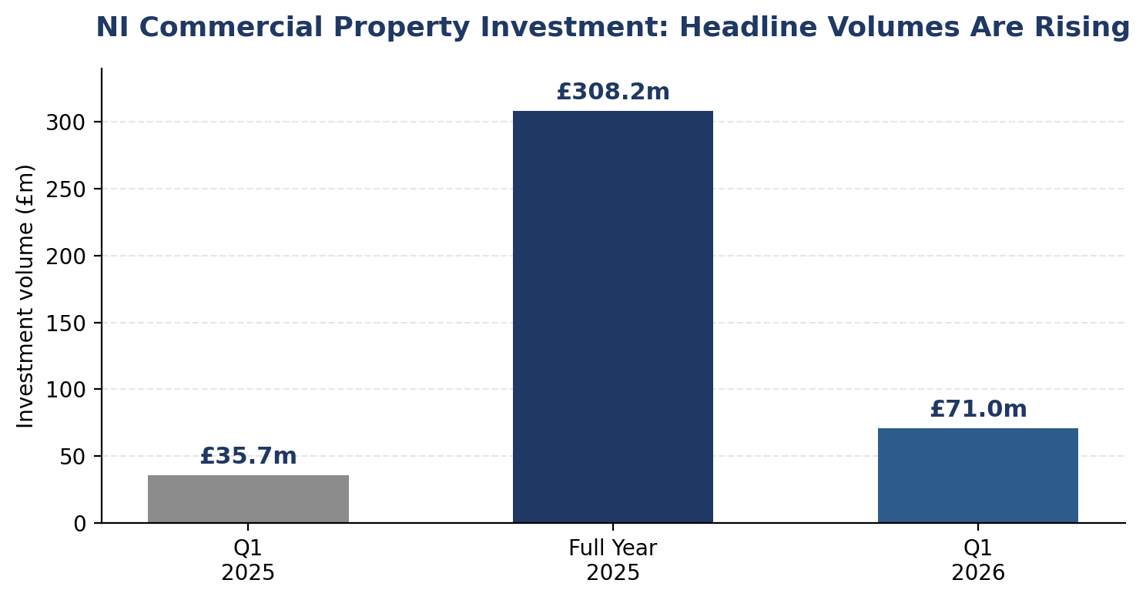
Source: CBRE NI Q1 2026 Commercial Property Market Report; Lambert Smith Hampton
Investment in the first quarter of 2026 reached roughly £71 million, effectively double the £35.7 million recorded in the same period a year earlier. Zoom out further, and 2025 as a whole saw around £308 million transacted across Northern Ireland - 8% above the five-year average - with local investors behind over four-fifths of that activity. By any measure, that is a market that is recovering.
A Market That’s Sticky, Not Stalled
But recovery isn’t the same as fluidity. CBRE’s own commentary on the first quarter describes a market that is "stable, but lacking momentum", pointing to viability constraints, rather than demand, as the real limiting factor. The industrial sector illustrates this well: enquiry levels continue to rise, particularly for larger requirements, but a shortage of high-quality, modern stock is capping how much of that demand can convert into completed deals. To be honest, this pattern of demand for space outstripping supply is nothing new and has been the case for over twenty years.
The retail sector tells a similar story from a different angle. Retail remains the dominant force in NI investment - and has been for the best part of fifteen years - but a lot of that volume now sits in a small number of very large transactions rather than broad-based churn. The average deal size across the market rose from roughly £4.9 million in 2024 to £8.9 million in 2025, nearly doubling.
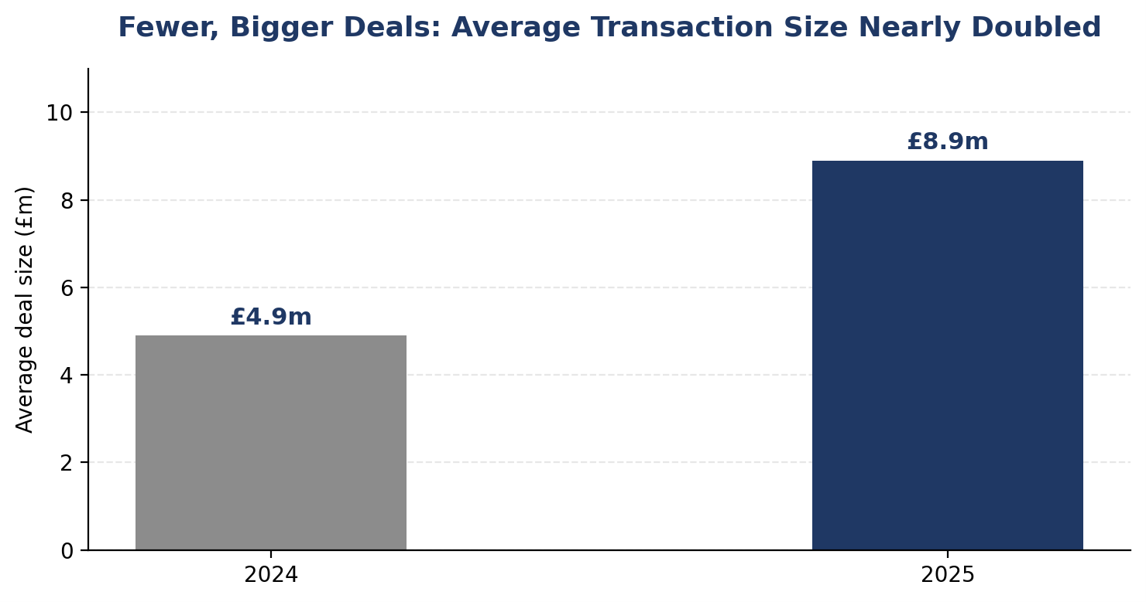
Source: CBRE NI
Put those two data points together and a pattern emerges: fewer assets are trading, but the ones that do are larger and more heavily contested. That is consistent with what we would call a "sticky" market - one where good stock is genuinely scarce, owners are in no hurry to sell, and pricing across most sectors has stayed broadly flat even as sentiment improves.
The Deals You Don’t See
A meaningful share of the activity we’re close to never reaches an agent’s window or a property portal at all.
Here is the part the published statistics cannot capture: in a market this tight, a meaningful share of the activity we are close to never reaches an agent’s window or a property portal at all. Deals are being done directly and privately, owner to buyer, often with terms and funding agreed before either side has any intention of testing the open market.
There are a few reasons this is becoming more common in Northern Ireland specifically:
Sellers avoid signalling intent. In a small market where everyone tends to know everyone, listing an asset openly can invite unwanted attention from competitors, tenants, or lenders before a seller is ready for that.
Buyers avoid competitive tension. With good stock scarce, an open process often leads to a bidding war. A direct approach to an owner can secure an asset at a fair price without creating that dynamic.
Relationships still drive Northern Ireland business. Ownership of commercial property here is concentrated among a relatively small group of local investors and family businesses - the kind of market where a phone call still does more than a listing.
Even some of the largest headline deals bear the hallmarks of negotiated, rather than fully competitive, terms. The quarter’s biggest transaction - the £26 million sale of the Amazon-let warehouse at Belfast’s Channel Commercial Park - closed several million pounds below the £29 million guide price originally quoted when the asset was brought to market. That is not evidence of an off-market deal specifically, but it is evidence of a market where pricing gets worked out through negotiation rather than competitive tension.
In our own practice at GDP, we have been involved in over £15M of sales and acquisitions alone in the first half of 2026, and that number will increase before the end of the year. None of this will be captured in official transaction figures for 2026. I would suggest that whatever the official year-end figure ends up at, you could add up to another 20% to reflect deals done off-market.
Why This Matters for Financing
Off-market deals move differently from open-market ones. There is no extended marketing period, no formal bid deadline, and often very little time between an opportunity emerging and a seller wanting certainty that funding is in place. For buyers, that means acquisition or bridging finance needs to be arranged - or at least firmly in principle - before an opportunity is even visible to anyone else.
That is increasingly where the value of a debt adviser sits: not just structuring finance once a deal is agreed, but ensuring a client is fund-ready before the right opportunity appears. In a market this sticky, speed and certainty of funding can matter just as much as price.
If you are watching the market from the sidelines and wondering why so little seems to be moving, the honest answer is that more is happening than the statistics show - just not necessarily where most people are looking.
That’s all for this week, and remember: if I can help you with any of your business needs right now, please reach out to me directly.
All the best,
Conor