
Lending Is Up – But Who Is Doing the Lending?
Last week we looked at the gap between record bank profitability and stubbornly high SME loan rejection rates. This week the headline has flipped: new data shows SME lending is genuinely rising. But "lending is up" is not the same question as "who is lending to you, and on what terms." That second question is where most business owners lose money, time, or both.
The Headline Number
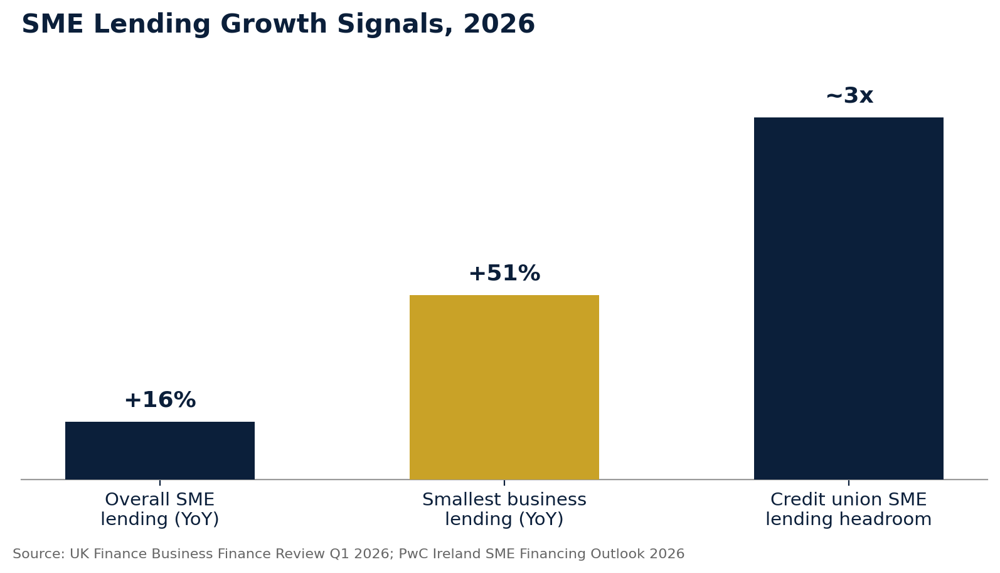
UK Finance's latest Business Finance Review shows SME lending rose 16% year-on-year to £5.3 billion in Q1 2026, the highest quarterly level since 2021. The smallest businesses saw the sharpest move, with lending to micro-enterprises up 51% year-on-year. Bank of Ireland has echoed the trend at group level, posting net loan growth and describing a "strong start" to 2026, with its Corporate & Commercial book gaining €0.5bn in Q1 alone, roughly €300m of that specifically Irish SME growth.
Meanwhile, credit unions, historically a footnote in SME finance, have had their business lending capacity expanded to 15% of assets since September 2025, close to trebling their prior headroom. On paper, the market has never had more capacity looking for a home.
Who's Actually Behind the Number
The 16% headline is an average across a market that is now more fragmented than at any point since the financial crisis. Each channel behaves differently on speed, on price, and on what it asks of you personally as a director.
High-street banks (AIB, Bank of Ireland, Danske): Lowest headline rates; slowest decisioning; risk appetite still cautious on new-to-bank cases.
Challenger & non-bank lenders (Funding Circle, Belfast Commercial Finance, OakNorth, Finance Ireland): Faster decisions (days, not weeks); pricing above high-street; growing share of GGS-backed lending.
Credit unions (Local & regional NI credit unions): Business lending headroom roughly trebled since Sept 2025; still underused by SMEs.
Private credit & bridging (Largely relationship-introduced, unregulated in parts): Fastest funding, highest cost, heaviest personal guarantee exposure; pricing rarely published or comparable.
The Part Nobody Publishes a Rate Card For
The fastest-growing corner of this market is private credit, bridging finance, mezzanine, and relationship-introduced lending outside the regulated bank panel. PwC Ireland's own outlook for 2026 describes non-bank and private credit as having "moved centre stage," with fund size and scope continuing to expand.
The Reality: There is no published rate card, no central register, and no easy way for a business owner to know if the terms they've been offered are competitive, or simply the only offer they got.
That's the part of the market that behaves like a black market. Not because it's illegitimate—much of it is entirely legitimate, and often the only route to funding a deal a high-street bank won't touch—but because pricing, structure, and personal guarantee exposure vary enormously from lender to lender, and almost none of it is transparent from the outside. Two businesses with near-identical deals can end up paying very different prices, simply because one owner had access to a wider panel and the other took the first offer that showed up.
Why This Matters For You
This is precisely the environment GDP Partnership is built for. We hold live relationships across the full spectrum: high-street banks, challenger and non-bank lenders, credit unions, and the private credit and bridging market. Therefore, a funding requirement gets tested against the whole panel, not just whichever door happens to be open. That's how we make sure the growth in lending actually reaches you at the right price and with the right structure, rather than taking the first number that lands on the table.
In Practice: A client recently came to us holding a facility offer already on the table from one of the high-street banks. Rather than accepting it as the market rate, we tested it against the wider panel. The result: a repriced offer on the same facility a full 1% better on margin, from a lender fully able to support the deal. Over the life of the facility, that single review saved the business a significant five-figure sum, simply because the first offer was never the only offer.
If you're weighing up a funding decision in the next quarter—refinancing, expansion, or an acquisition—now is a good time to have that conversation. The capacity is there. Getting it on the right terms is the part that takes advice.
As the kids are all racing back to school in the next two weeks, we are now entering one of our busiest times of the year at GDP, with lots of people trying to get business completed before the Christmas holidays.
If you are raising capital right now, or perhaps a facility needs to be refinanced, our team would love an opportunity to speak with you, so get in touch.
That’s all this week - look after yourself,
Conor